Article - Can’t We Just Cut the Roots Off?
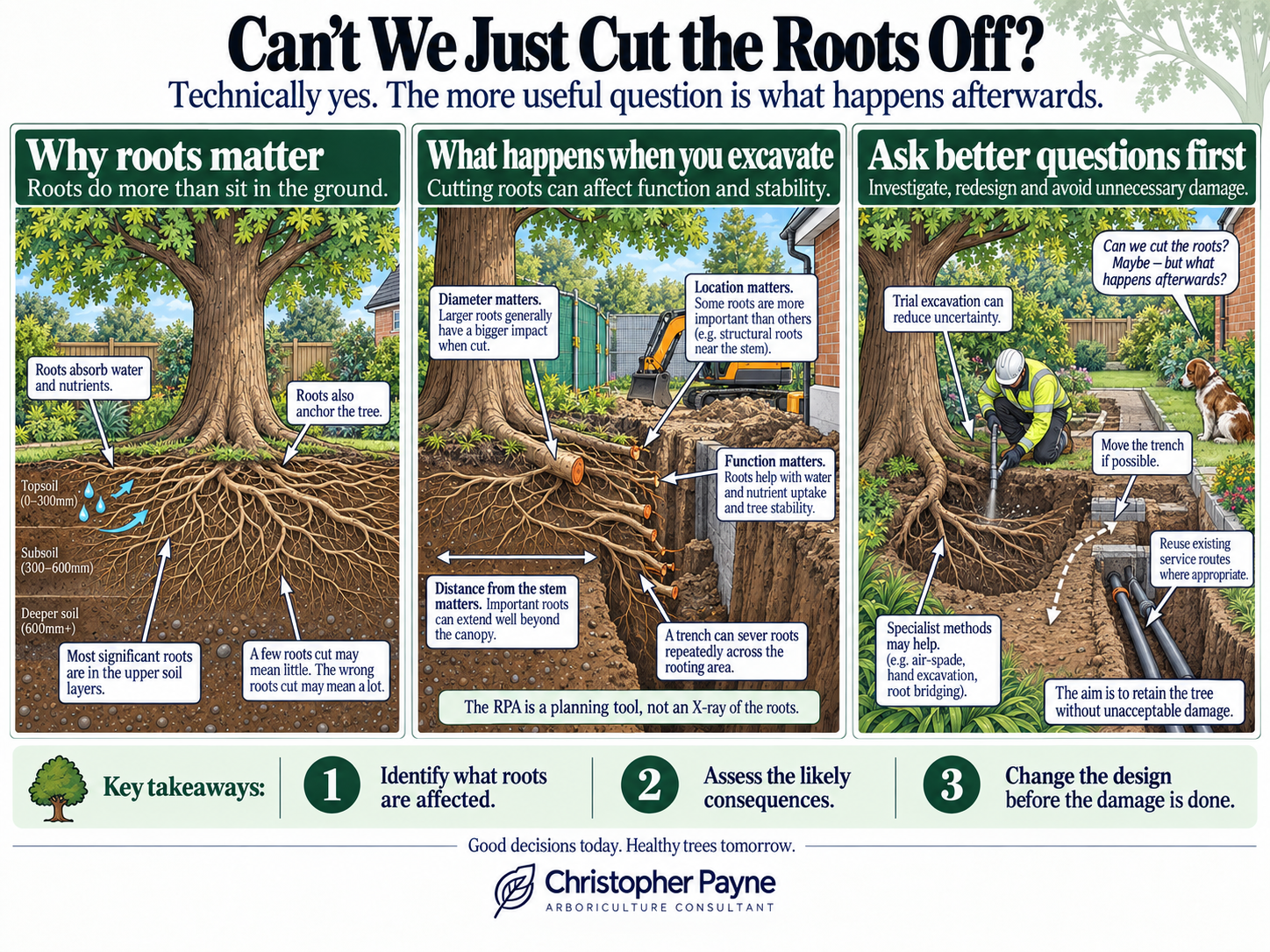
Can’t We Just Cut the Roots Off?
Technically yes. The more useful question is what happens afterwards.
There is a tree beside the proposed excavation.
The roots are inconvenient.
Someone therefore asks the entirely reasonable question:
“Can’t we just cut them off?”
Yes.
A chainsaw is remarkably persuasive.
Unfortunately, the conversation doesn’t end when the root does.
Roots do several rather important things
Most people understand that roots absorb water and nutrients.
They also anchor the tree.
This means that cutting roots can potentially affect both physiological function and structural stability.
The consequences depend upon considerably more than the number of roots encountered.
Their diameter matters.
Their location matters.
Their function matters.
The species and condition of the tree matter.
The distance from the stem matters.
The extent of root loss matters.
The rooting environment on the remainder of the tree matters.
This is why “we only found three roots” isn’t particularly useful information.
Three tiny roots and three major structural roots are rather different discoveries.
What does a root system actually look like?
Probably not like the tree you drew at school.
Trees generally don’t possess a perfectly proportioned underground mirror image of their crowns.
Root systems commonly spread laterally through relatively shallow soil, although their architecture varies enormously according to species and site conditions.
Roots exploit favourable conditions.
They encounter foundations, compacted ground, roads, pipes, drainage, different soil horizons and historic disturbance.
They adapt.
Consequently, the calculated Root Protection Area on a drawing is not an X-ray of the root system.
It is a planning and design tool.
“The foundations are two metres away”
Two metres from what?
The trunk?
The RPA?
The edge of the crown?
And what is being excavated?
A narrow hand-dug trench?
A basement?
Piled foundations?
A conventional strip foundation requiring working space and machine access?
Distance alone tells us remarkably little without understanding the proposed operation.
The trial excavation
Sometimes uncertainty can be investigated.
Carefully controlled exploratory excavation may establish whether significant roots are actually present in a particular location.
That doesn’t mean sending an excavator operator in with instructions to “have a careful scrape”.
Methods need to reflect the circumstances and purpose of the investigation.
The results then need interpreting.
Finding fewer roots than expected might allow a design to proceed.
Finding significant roots might justify changing it.
Both outcomes are useful.
That is what investigation is for.
Root pruning isn’t automatically forbidden
There are circumstances in which roots can be pruned.
The simplistic rule that no root may ever be cut is no more helpful than assuming roots can always be removed without consequence.
The significance of root pruning needs assessment in context.
Small roots at the edge of a rooting area may present a very different issue from severing substantial roots close to the stem.
Good arboriculture deals with degree, consequence and evidence.
Bad arboriculture deals in absolutes.
Then there is the trench
The service trench deserves special recognition.
It is long.
It is narrow.
And it has an extraordinary ability to intersect exactly the part of the site everyone agreed not to disturb.
A trench can potentially sever roots repeatedly across a rooting area.
Sometimes the solution is simple: move it.
Sometimes existing routes can be reused.
Sometimes specialist installation techniques are appropriate.
What isn’t particularly sophisticated is excavating the trench first and asking the arboriculturist what to do with the roots afterwards.
At that point, our design options have become somewhat limited.
So can we cut the roots?
Maybe.
That is the technically honest answer.
But first we need to know what roots are likely to be affected, where they are, what function they may perform, how much of the root system is potentially affected and what consequences this might have for the tree.
The objective isn’t to protect every root.
It is to avoid causing unacceptable damage to the tree we have supposedly decided to retain.
Because there is very little point designing an entire development around a retained tree and then removing the bits that hold it up.
Christopher Payne | Arboriculture Consultant