Article - That Tree Looks Dangerous
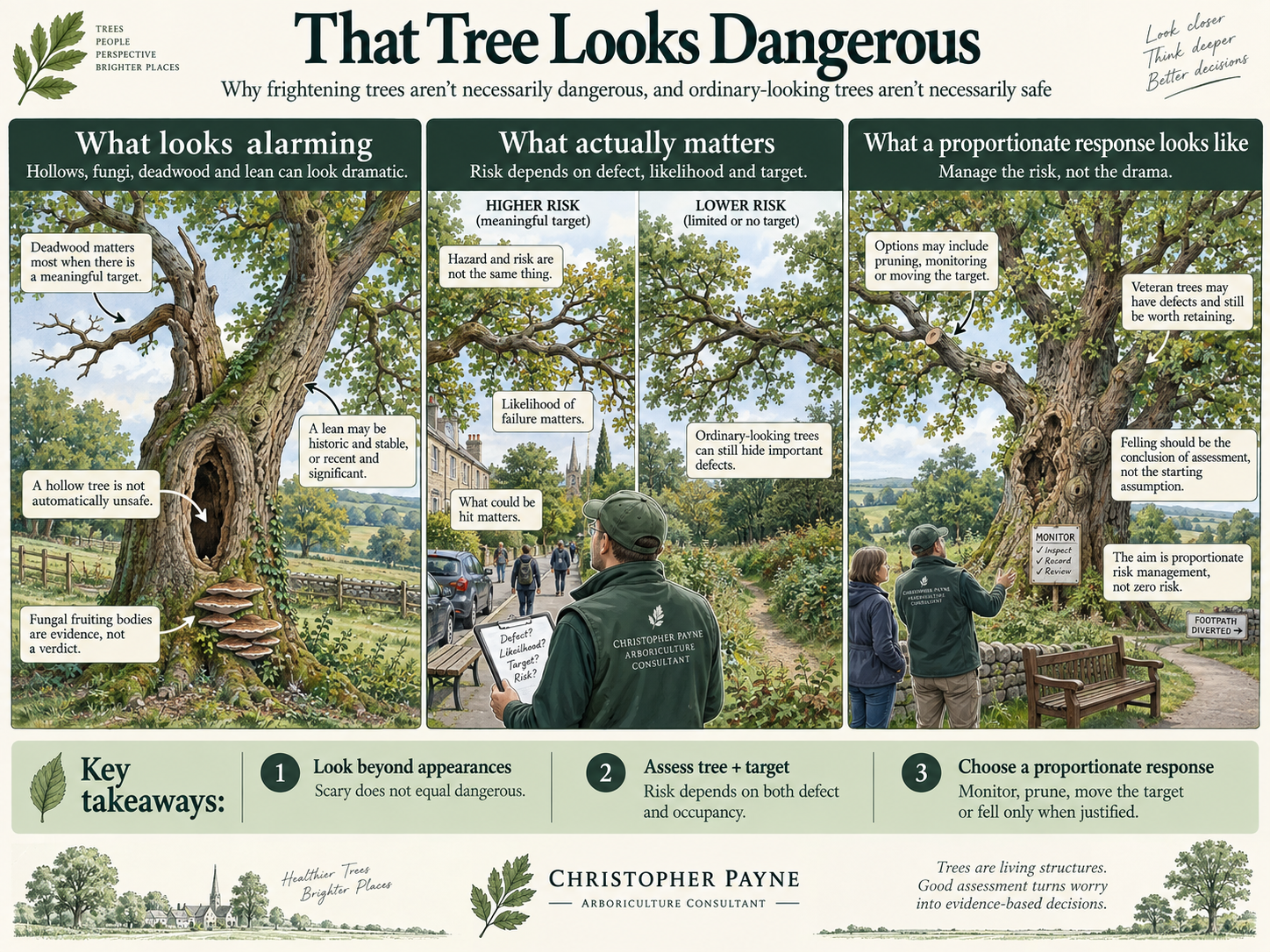
Why frightening trees aren’t necessarily dangerous, and ordinary-looking trees aren’t necessarily safe
The tree has a hole in it.
There is fungus at the bottom.
One branch is dead.
It leans.
It creaks in the wind.
Clearly it must be dangerous.
Perhaps.
But trees are inconveniently resistant to diagnosis by adjective.
“Scary”, “massive”, “old” and “wonky” aren’t recognised measurements of risk.
Hazard and risk aren’t the same thing
A tree may contain a defect capable of contributing to failure.
That is relevant.
But risk also depends upon what could be affected and the likelihood of the relevant events occurring.
A defective branch over a permanently occupied area presents a different situation from the same branch extending over an inaccessible patch of scrub.
This doesn’t make the defect disappear.
It changes the risk.
The hollow tree
Hollows alarm people.
Understandably.
We tend to associate missing material with weakness.
But hollowing is a normal feature of many old trees.
Trees can continue growing around decayed or hollow sections for very long periods.
Whether a particular hollow is structurally significant depends upon its extent, location, the tree’s adaptive growth, loading and numerous other factors.
Hollow = dangerous = fell is not a defensible diagnostic method.
Fungus!
Few discoveries create more excitement than a fungal fruiting body at the base of a tree.
Photograph taken.
Internet searched.
Tree condemned before breakfast.
Fungi associated with trees vary enormously in their significance.
Identification matters.
Location matters.
Host species matters.
The extent and pattern of decay matter.
The tree’s response matters.
The target matters.
A fungal fruiting body is evidence.
It isn’t, by itself, a risk assessment.
But it leans
Most trees fail to observe the architectural preference for vertical columns.
A lean can result from growth toward light, historic competition, slope, wind exposure, partial failure or many years of ordinary development.
A longstanding lean with appropriate adaptive growth is very different from a recently developing lean accompanied by ground movement.
Context changes everything.
Deadwood
Dead branches can fail.
This isn’t controversial.
The significance depends upon their dimensions, condition and location.
Large dead branches above a busy pedestrian area deserve different attention from small dead twigs over woodland floor.
Sometimes management means pruning.
Sometimes it means moving the target.
Sometimes it means doing nothing.
Risk cannot be reduced to zero
This is the uncomfortable part.
Trees are living structures exposed to weather.
Branches occasionally fail.
Whole trees occasionally fail.
A perfectly healthy-looking tree can fail under exceptional loading.
No inspection can guarantee that a tree will remain standing.
The objective of tree risk management isn’t to create a world in which trees cannot fail.
That world would contain remarkably few trees.
The objective is proportionate management of risk.
Removing every defective tree creates its own problem
If every hollow, fungal bracket, dead branch or lean resulted in felling, many of our most valuable veteran trees would disappear.
Old trees are often structurally complicated.
Those same trees may possess exceptional landscape, ecological, cultural and historical value.
The question therefore becomes:
Can the risk be managed while retaining the tree?
Perhaps targets can be moved.
Access can be altered.
Specific branches can be reduced.
Loading can be reduced through carefully designed pruning.
Monitoring can be introduced.
Further investigation may be justified.
Sometimes felling really is necessary.
But it should be the conclusion of the assessment, not the starting assumption.
The boring-looking tree
There is another side to this.
Some serious defects aren’t spectacular.
A tree can appear entirely ordinary to an untrained observer while displaying subtle symptoms that justify closer assessment.
Which is why visual drama is a poor substitute for inspection.
So, is that tree dangerous?
Possibly.
But pointing at it and saying “that looks dangerous” hasn’t taken us very far.
We need to understand the tree, the defect, the likelihood and consequences of failure, the people or property potentially exposed, and the management options available.
Sometimes the answer will be:
Yes, something needs doing.
Sometimes it will be:
No, leave it alone.
And occasionally the safest and most proportionate recommendation is considerably less dramatic than everyone was hoping for.
Trees are inconsiderate like that.
Christopher Payne | Arboriculture Consultant