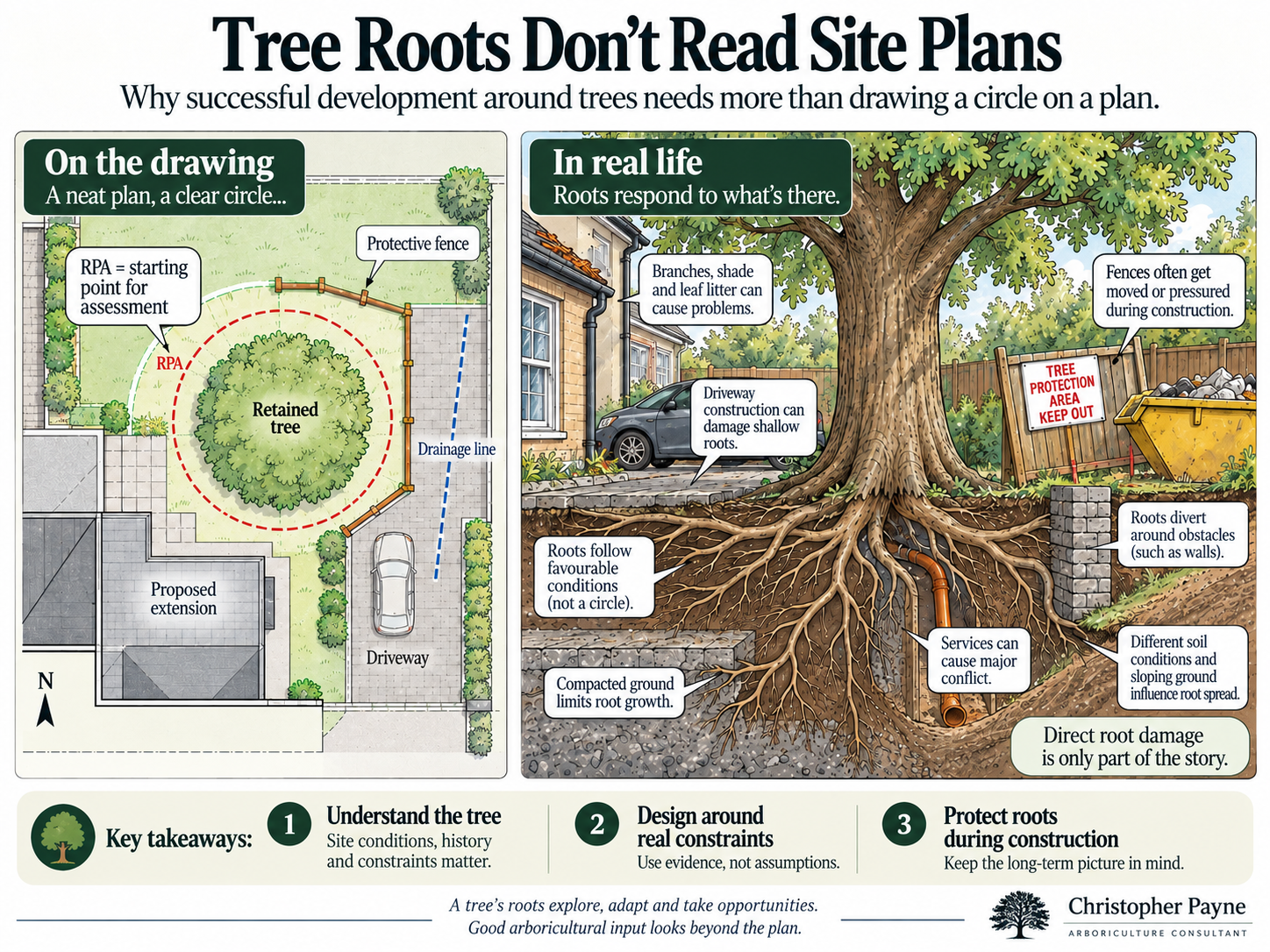
Article - Trees Don’t Read Site Plans
Why successful development around trees needs more than drawing a circle on a plan
One of the great conveniences of CAD is that everything stays exactly where you put it.
Lines remain straight. Buildings remain rectangular. Boundaries behave themselves. Dimensions are obedient to the nearest millimetre.
Trees, unfortunately, have never been trained in CAD.
Their roots do not grow in perfect circles. They don’t stop politely at the edge of a Root Protection Area. They don’t know where the proposed driveway is going. And they certainly haven’t read the architect’s site plan.
This is where arboriculture and development start to get interesting.
The famous Root Protection Area
Anyone who has encountered a tree survey for a planning application has probably seen the familiar circles drawn around trees.
These are Root Protection Areas, usually abbreviated to RPA.
Under BS 5837, the RPA provides a means of calculating an area around a retained tree that should normally be protected from potentially damaging activity during development.
The calculation starts with stem diameter.
For a straightforward single-stem tree, the RPA radius is broadly derived from twelve times the stem diameter, subject to the limits and methodology set out within the Standard.
So far, so mathematical.
Measure tree. Enter number. Draw circle.
Job done?
Not remotely.
The calculated RPA is a starting point for arboricultural assessment, not a magical force field containing every important root.
Unfortunately, roots are rather badly behaved
If you excavated the complete root system of a mature tree, you would rarely discover a beautiful symmetrical disc.
Root growth responds to the environment.
Roots exploit favourable soil conditions and avoid less favourable ones. Their distribution can be affected by buildings, roads, historic excavation, retaining walls, drainage, soil compaction, groundwater, topography and previous land use.
A tree beside an old stone wall, for example, may have a very different rooting pattern from an identical tree growing in an open field.
This matters because development sites are rarely blank sheets of paper.
A proposed extension might clip a calculated RPA but occupy ground that has already been heavily disturbed.
Conversely, something apparently innocuous outside the neat circle on the drawing might affect important rooting conditions, drainage or soil structure.
The answer is not to ignore the RPA.
The answer is to understand what it represents.
That distinction is surprisingly important.
Trees are not just roots
Development around trees is often reduced to one question:
“Can we build outside the RPA?”
It is the wrong question.
A technically competent assessment also needs to consider what happens above ground and what happens after the builders have gone home.
Imagine placing a new house immediately outside the RPA of a mature tree.
No roots are excavated. Excellent.
But now consider the finished relationship.
Will the tree heavily shade the main windows?
Will branches touch the building?
Will occupants feel threatened by a large tree close to the house?
Will leaf fall block gutters?
Will future owners immediately want the tree reduced or removed?
Will the development still work when the tree is twenty years older?
A scheme can avoid direct root damage and still create a terrible relationship between a building and a tree.
That isn’t successful tree retention.
It is deferred conflict.
The driveway problem
Driveways are another favourite.
A tree sits beside the proposed access and somebody announces:
“It’s only block paving.”
Unfortunately, trees are generally unimpressed by the retail price of the paving material.
The potential problems are underneath it.
Conventional construction can involve excavation, removal of topsoil, compaction of the formation layer, introduction of stone sub-base and changes to water and gas movement through the soil.
Fine roots responsible for much of a tree’s water and nutrient uptake commonly occupy relatively shallow soil.
Digging down 300 mm because “that’s what we normally do” can therefore be a distinctly arboricultural activity, just not a particularly desirable one.
Where construction within rooting areas is justified, specialist solutions may sometimes be possible.
These can include no-dig construction, cellular confinement systems, permeable surfacing, carefully designed load distribution and site-specific engineering.
But “no-dig” does not mean “no thought”.
Putting a geocell on the ground and hoping for the best isn’t a design methodology.
The levels, loading, existing soil condition, permeability, edge restraints, installation method and intended use all matter.
The tree protection fence that mysteriously moves
Tree protection barriers provide another fascinating insight into human behaviour.
On the approved Tree Protection Plan, the fence is immaculate.
It forms an elegant line around the retained tree.
On site, three weeks later, it has occasionally developed the remarkable ability to migrate.
Usually toward the tree.
Apparently this happens because builders need somewhere to store bricks, park a mini excavator, place a skip, mix concrete or make life generally more convenient.
Trees tend to lose these arguments because they rarely attend site meetings.
This is why tree protection needs to be practical.
A fence that makes construction impossible will eventually become a fence that somebody moves.
Good arboricultural planning therefore needs to consider how the site will actually function.
Where will materials be stored?
How will machinery reach the rear of the site?
Where will services run?
Where will scaffolding stand?
How will demolition occur?
Where will spoil go?
If these questions are answered before construction starts, retained trees have a much better chance of remaining genuinely retained.
Services: the thin lines that cause large problems
Drainage and utilities deserve particular suspicion.
On planning drawings they often appear as pleasantly thin lines.
Unfortunately, the trench required to install the pleasantly thin line may be considerably wider.
A drainage run crossing an RPA can potentially involve excavation through the rooting environment of several retained trees.
Sometimes routes can be changed.
Sometimes existing service corridors can be reused.
Sometimes trenchless installation or carefully controlled excavation may be appropriate.
The important part is recognising the conflict while somebody is still sitting in front of a computer.
Discovering it when an excavator bucket encounters a 150 mm diameter root is considerably less elegant.
Good arboriculture is partly about avoiding arguments that haven’t happened yet
The best arboricultural input to a development isn’t necessarily the report that contains the most pages.
It is the work that identifies conflicts early enough for somebody to do something useful about them.
Move the garage half a metre.
Alter the parking layout.
Change a drainage route.
Adjust finished levels.
Retain a better tree and remove a poorer one.
Use a different construction detail.
Design new planting into somewhere it can actually grow.
None of these decisions is particularly glamorous.
But collectively they can be the difference between a development that successfully accommodates trees and one that spends the next twenty years fighting them.
And this is where drawings matter
Arboricultural reports contain plenty of words.
Development happens on plans.
A good Tree Constraints Plan, Tree Protection Plan or Arboricultural Method Statement drawing should therefore communicate quickly and precisely.
The reader should be able to understand:
which trees are retained;
which are removed;
where their RPAs lie;
where protective barriers are installed;
where special construction methods apply;
how access works;
where arboricultural supervision is required; and
how all of this relates to the actual proposed development.
If somebody has to read six paragraphs to discover where a fence goes, the drawing has failed.
Clear, scaled CAD drawings aren’t decoration added to an arboricultural report.
They are part of the technical solution.
Trees and development don’t have to be enemies
Trees frequently make development more complicated.
They can also make finished developments considerably better.
Mature trees provide scale, landscape structure, screening, shade, habitat and an immediate sense of establishment that newly planted landscaping may take decades to achieve.
The trick isn’t simply to “save every tree”.
Nor is it to remove anything inconvenient.
It is to understand the quality and condition of the existing trees, identify the genuine constraints, design intelligently around the worthwhile ones and provide realistic protection during construction.
That requires a mixture of arboriculture, planning, design, construction knowledge and occasionally the ability to explain why storing twelve tonnes of bricks beneath a protected oak might not be ideal.
Which brings us back to the original problem.
CAD is precise.
Development drawings are precise.
Trees aren’t.
And that is exactly why somebody needs to understand both.
Christopher Payne | Arboriculture Consultant