Arboricultural advice fees vs the £50k problem
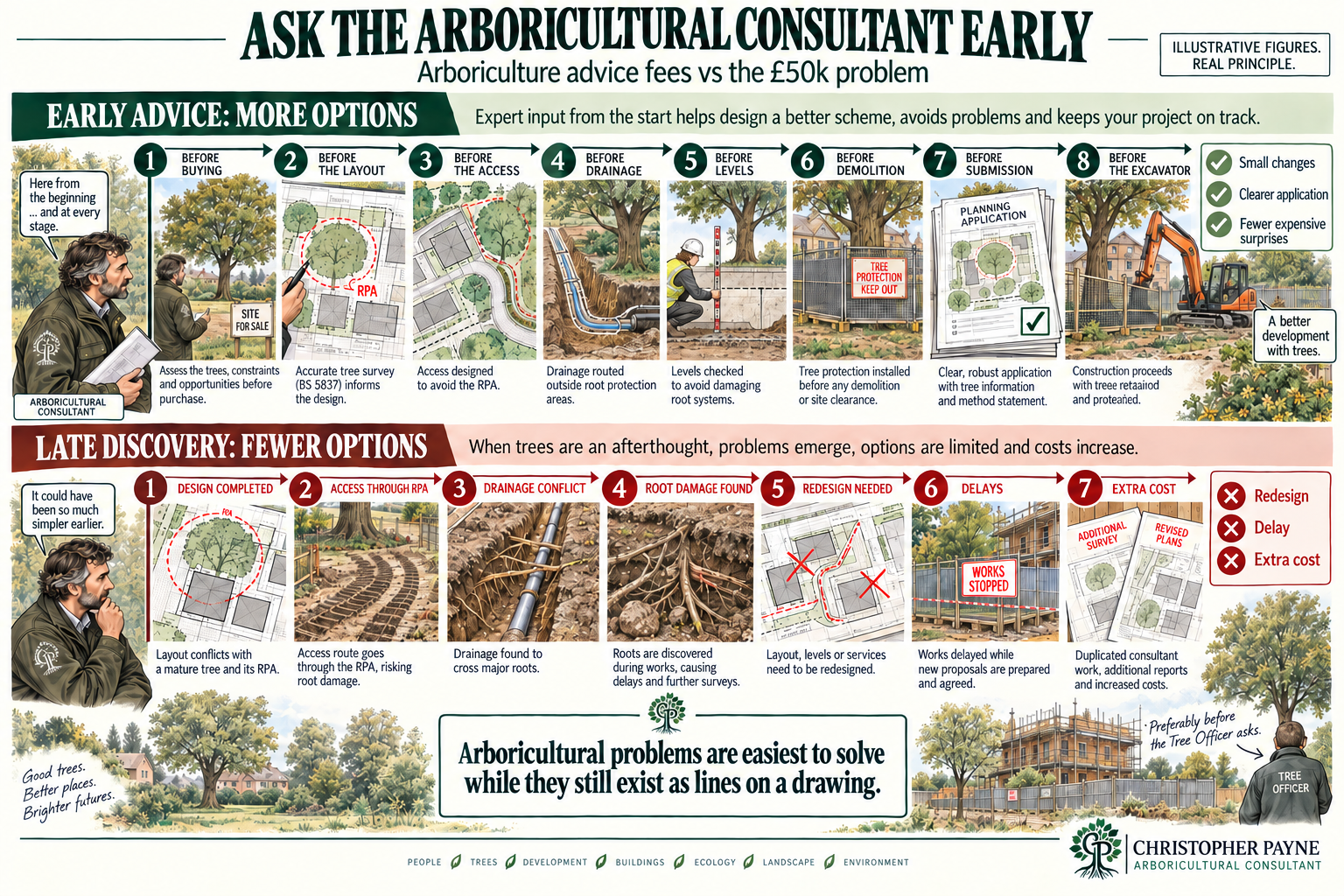
The figures in this article are illustrative. The principle isn’t.
A developer is considering a site.
There are several mature trees. An arboricultural survey is suggested.
“Do we really need that yet?”
Fair question.
The architect could design the scheme first. The engineers could begin their work. Access, drainage and levels could all be developed before the arboricultural consultant becomes involved.
What could possibly go wrong?
The problem isn’t usually that trees make development impossible.
It is that discovering the real tree constraints after everything else has been designed leaves fewer, more expensive options.
The same site, two different approaches
Version one: arboriculture comes first
The trees are surveyed before the layout becomes fixed.
Two are identified as significant constraints. Several others are of relatively limited value. Their positions, crown spreads, stem diameters and Root Protection Areas are accurately recorded.
The architect receives reliable tree information and designs accordingly.
Parking moves slightly.
One building shifts.
The access takes a different line.
Drainage is routed away from the most sensitive rooting areas.
The important trees remain, while the poorer trees don’t dictate the entire scheme.
The planning application is submitted with the arboricultural relationships clearly explained.
Not particularly exciting.
That is the point.
Version two: arboriculture comes last
The architect completes the design.
Planning drawings are produced. Engineering begins. Drainage is designed. Levels are agreed and the application is submitted.
Then somebody asks for an Arboricultural Impact Assessment.
The tree survey identifies an important retained tree where the access is proposed. Another stands uncomfortably close to a building. Drainage crosses a Root Protection Area and the proposed levels require excavation around retained trees.
The choices are now less attractive:
Redesign the scheme.
Commission revised engineering and drainage work.
Attempt to justify significant tree impacts.
Remove trees that the planning authority may consider important.
Continue and hope the Tree Officer doesn’t notice.
The last option isn’t a strategy.
The expensive part isn’t necessarily the arboriculture report
It is everything that may have to be done again.
Architectural work.
Engineering.
Drainage.
Landscape design.
Planning drawings.
Consultant coordination.
Cost estimates.
Client approvals.
Possibly the planning application itself.
The £50,000 in the title is deliberately illustrative. It isn’t a claim that every overlooked tree constraint produces a £50,000 bill.
Sometimes the cost of redesign is modest. Sometimes it is substantial.
The principle is far less controversial: changing a development while it consists of lines on a screen is generally easier than changing it after several consultants, a client and a planning authority have started relying on those lines.
Early advice doesn’t mean trees dictate the development
An arboricultural consultant’s job isn’t to draw circles around every tree and declare the rest of the site available.
Early assessment helps establish:
Which trees are genuinely important.
Which trees are of limited value.
Which constraints are fixed.
Which relationships can be managed.
Where construction may require a specialist approach.
Where small design changes could avoid larger problems.
Whether statutory tree protection affects the options.
That information allows the design team to respond to actual constraints rather than assumptions.
Sometimes the trees aren’t a significant problem.
Sometimes they are.
Either answer is useful when obtained early enough.
Useful times to ask
Before buying the site
That magnificent belt of mature trees may be one of the reasons the site is attractive.
It may also occupy part of the land intended for development.
Are the trees protected? What quality are they? How much of the site do they realistically constrain? Could a suitable relationship with development be achieved?
Finding out before purchase can be useful.
Occasionally very useful.
Before finalising the layout
This is the big one.
Once everybody becomes attached to a layout, moving anything becomes strangely difficult.
Early tree information allows buildings, roads, parking, gardens and open space to respond to genuine constraints.
A metre moved on a drawing may prevent an expensive argument later.
Before positioning the access
Vehicle access has requirements.
So do trees.
Access construction may involve excavation, level changes, visibility splays, hard surfacing and repeated vehicle loading.
The elegant entrance through the mature tree belt deserves investigation before it becomes the centrepiece of the design.
Before designing drainage
Drainage engineers draw lines.
Tree roots occupy soil.
Eventually the two meet.
Coordinating drainage and tree constraints early is usually easier than rerouting an engineered system after the layout has been agreed.
Before agreeing levels
A building platform may work perfectly in plan while requiring substantial excavation or filling around retained trees.
Plans tell only part of the story.
Sometimes the section is where the trouble lives.
Before demolition
The building being demolished may stand beside trees intended for retention.
Demolition requires machinery, access, storage and working space, just as construction does.
Tree protection therefore starts before the new foundations and, in many cases, before the old building comes down.
Before submitting the application
An application isn’t improved by leaving obvious arboricultural questions unanswered and hoping nobody notices.
Somebody may notice.
Possibly a Tree Officer.
A strong submission makes the important relationships easy to understand. It shows what will be retained, what will be removed, how the design responds to the trees and how construction can proceed without unacceptable damage.
Before telling the client, “The trees won’t be a problem”
This is an especially good moment.
They may not be a problem.
But it is better to know than to improvise confidently.
Preferably before the excavator arrives
The same principle applies during construction.
Discovering important roots before excavation provides options.
Discovering them hanging from the side of a trench provides fewer.
Finding out that specialist surfacing is required before construction is priced is useful. Discovering it after conventional levels and specifications have been agreed is less useful.
Concrete, drainage, foundations and construction contracts make creativity more expensive.
Ask the useful question
Good professional advice has a cost.
So does redesign.
So does delay.
So does damaging a tree that planning permission requires to be retained.
The sensible question isn’t:
“How cheaply can we obtain a tree report?”
It is:
“What arboricultural information do we need, and when do we need it?”
Sometimes the cheapest arboricultural advice is the advice obtained before anyone thinks they need it.
Or, to put it another way:
Ask the arboricultural consultant before the Tree Officer has to ask you.
That tends to work rather better.
Christopher Payne | Arboricultural Consultant