Why the Cheapest Tree Report Can Cost More
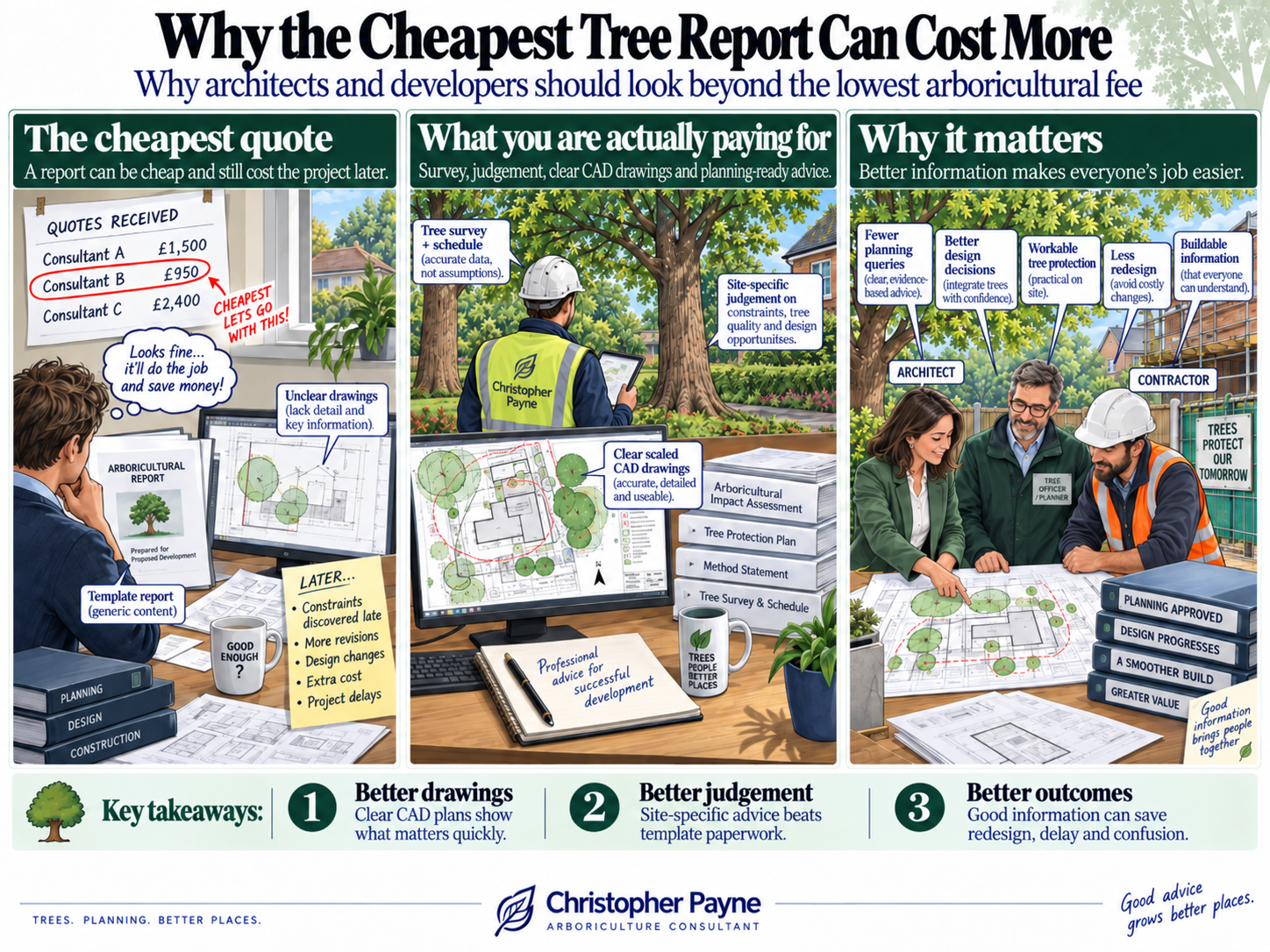
Why architects and developers should look beyond the lowest arboricultural fee
Architects are quite accustomed to paying for expertise.
Structural engineers are not normally appointed because they produce the cheapest calculations.
Drainage consultants are not selected solely according to how little they charge per manhole.
Nobody seriously suggests choosing a planning consultant because their report contains the greatest number of words per pound.
Yet arboricultural consultancy can sometimes be treated rather differently.
A drawing arrives showing trees around a proposed development.
Someone says:
“We need a BS 5837 report.”
Three quotations are obtained.
One is £499.
One is £950.
One is £1,850.
The temptation is obvious.
They are all tree surveys, aren’t they?
Possibly.
In approximately the same way that every architectural drawing is a drawing.
The interesting question is what you actually get.
BS 5837 is not a document
This is the first point worth understanding.
A BS 5837 commission should not simply produce a report.
It should help the design team understand the site.
For a typical development project, that may involve:
identifying and assessing the existing trees;
preparing a tree schedule;
plotting the trees accurately against the site;
showing crown spreads and Root Protection Areas;
identifying which trees genuinely influence the design;
assessing the effects of the proposed development;
resolving conflicts where possible;
designing workable tree protection;
explaining specialist construction where necessary; and
presenting all of this clearly enough for architects, planners, tree officers and contractors to understand it.
That is quite a lot more than:
“Survey trees. Insert data into template. Send PDF.”
The difference matters because the arboricultural information becomes part of the design process.
If it is poor, everybody else has to work harder.
The report is not usually the bit architects struggle with
Most architects can cope with prose.
The real difficulty is coordinating information spatially.
Where exactly is the tree?
How far does the crown extend?
Where is the Root Protection Area?
What is proposed for removal?
Where does the proposed building conflict?
Where can construction take place?
What happens to the driveway?
Where does the protective fencing go?
Can scaffolding still be erected?
Where are the services supposed to run?
This is why I place so much emphasis on CAD drawings.
In my experience reviewing arboricultural submissions from the local-authority side, the quality of BS 5837 drawings varies enormously.
Some are excellent.
Others technically contain the required information but make the reader work far too hard to understand it.
And some appear to regard the drawing as the unfortunate administrative task required after the real work of writing the report has finished.
I take the opposite view.
The drawing is part of the professional advice.
A good drawing saves everybody time
Imagine two Arboricultural Impact Assessments.
The first contains fifteen pages explaining that several proposed construction operations occur close to retained trees.
Eventually, somewhere around paragraph 8.4.3, the reader discovers that the proposed driveway enters the Root Protection Area of T7.
The second shows the relationship clearly on a scaled drawing.
T7.
Its crown.
Its RPA.
The driveway.
The area of encroachment.
The proposed construction method.
The relevant annotation.
Same arboricultural issue.
Very different communication.
For an architect, that distinction is important.
A clear drawing allows you to understand the constraint immediately and decide what to do about it.
A poor drawing creates another coordination exercise.
I prepare the drawings because I am doing the assessment
This is one of the reasons my service is not designed around producing the cheapest possible report.
I survey the site.
I assess the trees.
I consider the proposed development.
I prepare the CAD drawings.
I write the report.
Those activities inform one another.
If I identify an important relationship while drawing the Arboricultural Impact Assessment, that can influence the written assessment.
If the proposed access creates a problem, I can examine the geometry.
If a protection fence works beautifully in theory but leaves no practical construction route, I can see that.
There is no need to explain the site to somebody in another department who has never visited it and is producing the drawing from survey notes.
For a large organisation processing high volumes of work, dividing tasks between surveyors, report writers, CAD technicians and administrators can be perfectly sensible.
It is also a different business model.
Mine is deliberately small.
The person who looks at the tree is the same person deciding what it means.
Templates are useful. Until the site stops behaving like the template.
There is nothing inherently wrong with standardisation.
Every competent consultancy uses standard procedures, drawing conventions, survey fields and report structures.
The problem begins when the standard document starts driving the assessment rather than the other way around.
Real development sites are irritatingly individual.
A tree may sit beside a retaining wall.
The RPA may overlap an existing building.
A proposed extension may require working space rather than simply foundation excavation.
The driveway may need an unusual no-dig detail.
Levels may matter.
Drainage may matter.
The architect may already have redesigned the scheme twice.
At that point, three paragraphs copied from a standard BS 5837 report about protective fencing are not the difficult part.
The difficult part is understanding this site.
Architects need arboricultural information they can design with
The best time for arboricultural input is often before the design becomes expensive to change.
A good Tree Constraints Plan should help answer questions such as:
Which trees deserve to influence the layout?
Where are the genuine constraints?
Which apparent constraints are less significant?
Where is there room to manoeuvre?
Can an access be adjusted?
Would moving the building half a metre materially improve the relationship?
Would removing a mediocre tree allow a much better tree to be retained?
That is useful design information.
A tree report commissioned after the layout has been finalised may still be necessary.
But it is then often documenting conflicts rather than helping avoid them.
I would much rather tell an architect:
“Move this slightly now.”
than spend several pages later explaining why the completed layout has created an avoidable problem.
More expensive does not necessarily mean more elaborate
This is another distinction.
I am not interested in producing a longer report simply to justify a higher fee.
Quite the opposite.
A good report should be proportionate.
A straightforward house extension does not need an arboricultural thesis.
What it does need is the right information.
Good survey.
Clear schedule.
Accurate drawing.
Relevant assessment.
Workable protection.
Site-specific method where necessary.
Nothing important missing.
Nothing included simply because it was in the template.
The value is not measured in pages.
The cheapest quote can become expensive remarkably quickly
Suppose an arboricultural report saves £400 at appointment stage.
Good result.
Now suppose the planning officer or tree officer subsequently asks for:
a revised Tree Protection Plan;
better information about an RPA incursion;
an Arboricultural Method Statement;
clarification of construction methods;
an amended drawing showing drainage;
or a redesign because a significant tree constraint was not identified properly at the beginning.
That £400 saving has become rather theoretical.
The architect spends additional time.
The planning consultant spends additional time.
The client becomes irritated.
The application slows down.
Drawings are revised.
Consultants start exchanging emails containing phrases such as:
“Further to the Council’s latest comments…”
Nobody’s favourite sentence.
A consultant who costs a little more but reduces that friction can be very cheap indeed.
Planning authorities do not assess the invoice
This is worth remembering.
When arboricultural information reaches the planning authority, nobody knows whether the client paid £400 or £2,400 for it.
They see the result.
Can they understand the trees?
Can they understand the proposal?
Are the impacts clear?
Are the conclusions supported?
Does the Tree Protection Plan make sense?
Could somebody actually build the scheme while following the Arboricultural Method Statement?
That is the test.
And because I also spend part of my professional life assessing development proposals from the local-authority side, I am acutely aware of how frustrating poor arboricultural information can be.
A report does not need to agree with the Tree Officer.
It does need to give them something technically coherent to assess.
Difficult sites expose the difference
Routine projects can make almost any consultancy model look good.
The difference becomes clearer when the site is awkward.
A mature tree sits close to the proposed extension.
An RPA conflicts with the access.
There is existing hard surfacing.
Levels change.
The drainage route crosses the rooting area.
A tree is protected.
The architect needs to know whether to redesign or whether the conflict can reasonably be addressed.
This is where a consultant needs to do more than identify the problem.
They need to help resolve it.
Sometimes the answer is specialist construction.
Sometimes the layout moves.
Sometimes the RPA can legitimately be modified.
Sometimes the tree should be removed.
Sometimes the proposed relationship is simply poor and pretending otherwise wastes everybody’s time.
That judgement is what the fee is buying.
There is also value in saying no
An architect recommending a consultant to a client is putting some of their own reputation into the decision.
That matters.
You do not want a consultant whose default response is:
“Yes, I’m sure we can justify that.”
Sometimes we cannot.
If I think an arboricultural argument is weak, I would rather say so while the design can still change.
That is more useful than producing an impressive-looking report that collapses as soon as somebody competent examines it.
Equally, where I believe something is technically reasonable, I am perfectly comfortable explaining why.
Consultancy should reduce uncertainty.
It should not manufacture confidence.
Large consultancies are not automatically bad
They plainly are not.
Large companies can offer substantial resources, geographic coverage, specialist staff and the capacity to mobilise quickly on major projects.
For some commissions they are exactly the right choice.
The comparison is not:
large consultancy bad, small consultancy good.
The real question is what service model suits the project.
For the sort of projects I particularly enjoy, individual dwellings, extensions, smaller development sites and complicated tree-development relationships, there is considerable value in continuity.
One consultant understands the site from survey through to final drawing.
That is the model I offer.
Why I may cost more
The explanation is actually quite simple.
I am not trying to be the cheapest producer of BS 5837 reports.
I am selling professional time.
Site assessment.
Judgement.
CAD work.
Planning experience.
Iteration with the design.
And direct responsibility for the finished product.
That model does not compete particularly well with high-volume consultancy on price.
It is not intended to.
It competes on the quality and usefulness of the result.
What I would want an architect to tell a client
Not:
“This is the cheapest arboricultural consultant.”
And not:
“He produces enormous reports.”
Something closer to:
“He isn’t necessarily the cheapest, but his work is clear, his drawings are particularly good, he understands planning and development, and I know the arboricultural information will be properly thought through.”
That is the market I want.
Because the objective is not to win every tree survey.
It is to work with architects, planning consultants and developers who recognise that a good consultant should make the rest of the project easier.
So, is the more expensive tree consultant worth it?
Sometimes no.
For an extremely simple commission, a competent lower-cost provider may be entirely adequate.
There is no virtue in paying for expertise that the project does not need.
But when trees genuinely influence the design, when the planning relationship matters, when the drawings need to integrate properly with the architectural information, or when the site contains awkward constraints, the quality of the arboricultural work becomes much more important.
The difference between a cheap report and a good report is not necessarily what either one says about trees.
It is what everybody else can do with the information.
And if the architect can understand it, the planner can assess it, the Tree Officer can follow the reasoning and the contractor can actually build from it, then the extra few hundred pounds spent at the beginning of the process may turn out to be one of the cheaper decisions on the project.
Christopher Payne | Arboricultural Consultant