Article - The Root Protection Area
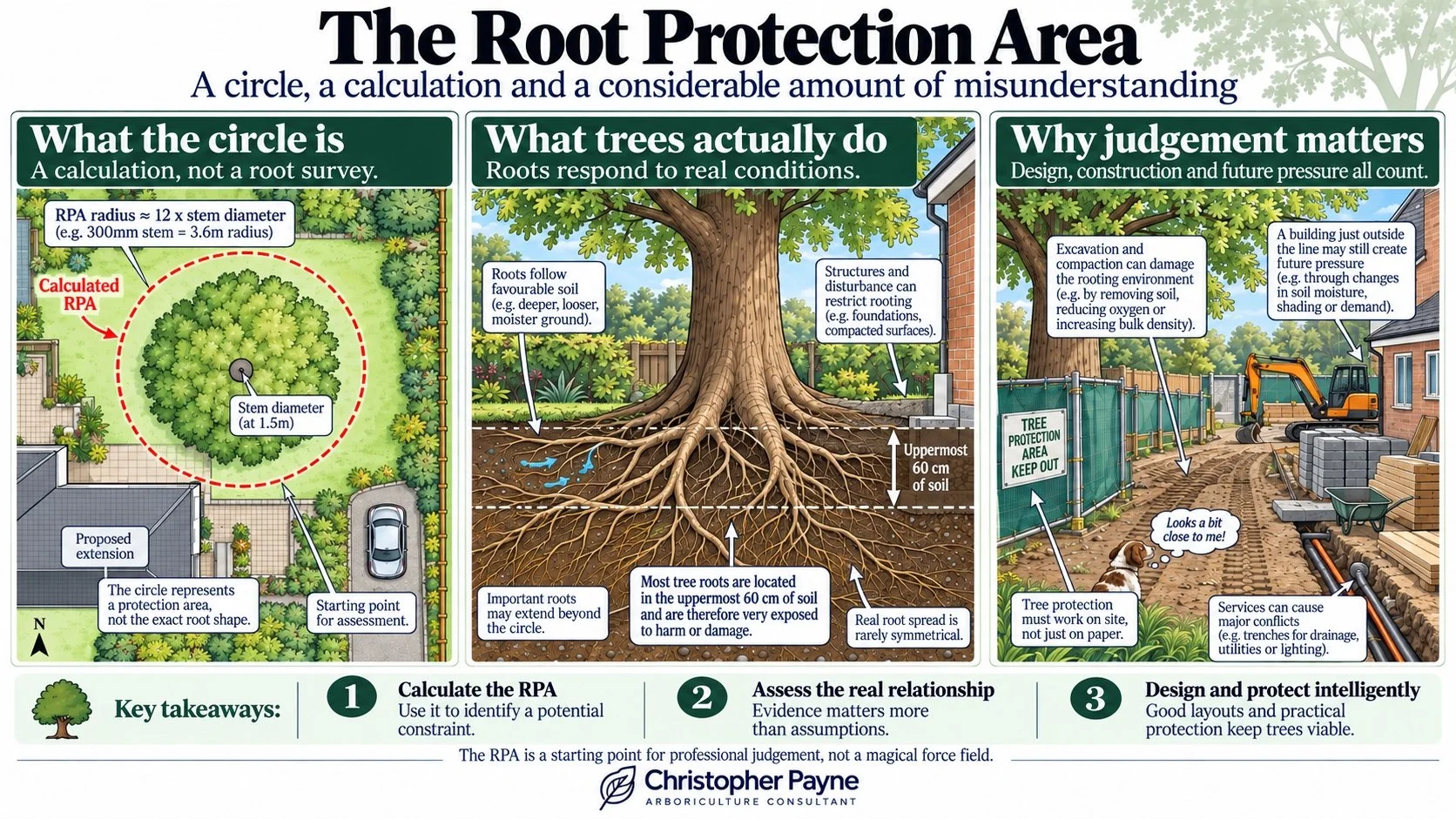
A circle, a calculation and a considerable amount of misunderstanding
There are few things in arboriculture quite as reassuring as a Root Protection Area drawn on a CAD plan.
A tree sits in the middle. Around it is a beautifully precise circle. The circle has a known radius, a known area and, if the drawing is good, a satisfyingly accurate lineweight.
Everything inside is apparently tree territory.
Everything outside is apparently development territory.
Unfortunately, nobody has explained this arrangement to the tree.
So what exactly is an RPA?
The Root Protection Area, or RPA, is one of the fundamental concepts used when assessing trees in relation to development.
BS 5837 provides a method for calculating the RPA of trees that are intended to be retained. In simple terms, stem diameter is used to derive an area considered sufficient to protect the tree’s rooting environment during development.
For a straightforward single-stem tree, the starting point is effectively a radius equivalent to twelve times the stem diameter, subject to the methodology and maximum area prescribed by the Standard.
A tree with a 500 mm stem diameter therefore starts with an RPA radius of approximately 6 metres.
That gives an area of about 113 square metres.
Which sounds generous.
Until somebody wants to put a house in it.
The first misunderstanding: the RPA shows where the roots are
It doesn’t.
The RPA is a calculated protection area. It isn’t a root survey.
This distinction matters.
Real root systems are influenced by soil structure, moisture, oxygen availability, previous disturbance, buildings, roads, retaining structures, drainage and numerous other factors.
Roots proliferate where conditions favour them and are restricted where they don’t.
Consequently, the actual root system of a tree might extend considerably beyond the calculated RPA in one direction while being relatively restricted in another.
Drawing the RPA as a circle doesn’t mean the roots have arranged themselves accordingly.
It means the circle is the default geometric representation of the calculated area.
Trees remain stubbornly biological.
The second misunderstanding: nothing can ever happen inside an RPA
This is almost the opposite error.
An RPA should certainly be treated seriously. Development within it can damage roots, compact soil and alter the conditions upon which retained trees depend.
But the existence of an RPA doesn’t automatically mean that every square centimetre within it is untouchable.
BS 5837 allows the shape of an RPA to be modified where there is sound arboricultural justification, while maintaining adequate protection of the rooting environment.
That is an important provision.
It is also occasionally interpreted rather creatively.
“We’ve moved the RPA because that’s where the extension needs to go” isn’t arboricultural justification.
The development layout doesn’t determine where the tree’s rooting environment is likely to be.
Evidence does.
Moving the circle
Suppose a mature tree stands three metres from a substantial building that has existed for a century.
Its calculated circular RPA extends straight through the building.
Clearly the tree doesn’t have several metres of functioning soil beneath the sitting room carpet.
The presence and history of that building may therefore be relevant when considering the likely rooting environment and whether an adjusted RPA can be justified.
Now consider the opposite side of the same tree.
There might be an undisturbed garden containing deep, well-structured soil.
That may have provided excellent rooting conditions for decades.
Redistributing part of the RPA toward that area could make biological and arboricultural sense.
This is fundamentally different from simply squeezing the RPA until the proposed development fits.
One is arboricultural assessment.
The other is geometry with ambitions.
The third misunderstanding: staying outside the RPA means the tree is safe
Unfortunately, no.
Roots are only part of the relationship between a tree and development.
A building positioned immediately outside an RPA might still create an entirely unacceptable relationship with the tree.
Consider a large mature tree with a broad canopy.
The proposed house avoids its RPA by 200 mm.
Success?
Perhaps not.
The canopy might overhang the roof. Principal windows might sit beneath dense shade. Branches may require repeated pruning. Future occupants may perceive the tree as dangerous. Leaf fall, honeydew, fruit, seeds or twigs may become sources of complaint.
The tree may survive construction perfectly well and then become the subject of a removal application five years later.
A development that technically avoids an RPA but creates inevitable future pressure for tree removal hasn’t necessarily accommodated the tree successfully.
It may simply have postponed the problem.
What actually causes damage inside an RPA?
The obvious answer is digging.
And digging certainly matters.
Fine roots responsible for much of a tree’s uptake of water and mineral nutrients can occur within relatively shallow soil. Excavation can therefore remove significant portions of the functioning root system remarkably quickly.
But excavation isn’t the only problem.
Soil compaction can be equally important.
Repeated vehicle movements, construction machinery or storage of heavy materials can compress soil, reducing pore space and altering the movement of air and water.
No trench is required.
No dramatic roots need to be severed.
The ground may simply become a considerably worse place in which to be a root.
Changes in levels can also matter.
Removing soil can damage roots directly.
Adding soil can alter aeration and moisture relationships.
Contamination from cement, fuels or other construction materials introduces another potential problem.
The absence of a chainsaw doesn’t mean the tree isn’t being damaged.
“But we’re only putting a driveway there”
This sentence has probably shortened the life expectancy of many arboriculturists.
A conventional driveway may require excavation and installation of a compacted sub-base.
From a highway engineering perspective, this is perfectly sensible.
From the perspective of a root system occupying the upper soil horizons, it may be less appealing.
This doesn’t mean that access or surfacing within an RPA is always impossible.
There are situations where appropriately designed no-dig construction, cellular confinement systems, permeable surfacing and other specialist solutions can allow limited construction while reducing impacts on the rooting environment.
But a no-dig specification is not a magic spell.
It needs to respond to actual site conditions.
Existing levels, soil condition, anticipated loading, drainage, edge restraints, construction access and installation sequence all matter.
Writing “no-dig construction” on a drawing and leaving everybody else to work out what that means on Monday morning isn’t an Arboricultural Method Statement.
It’s optimism.
Then there are services
Services have an extraordinary ability to appear late in the design process.
A carefully prepared site layout may retain trees, respect RPAs and provide sensible construction access.
Then somebody draws a foul drainage connection directly through the middle of everything.
A service trench can be particularly damaging because it creates a continuous excavation through the rooting environment.
The solution is usually much easier at design stage.
Change the route.
Use an existing service corridor.
Consider trenchless techniques where appropriate.
Coordinate arboricultural and engineering information before construction begins.
It is considerably easier to move a line on a computer than a mature oak.
The RPA during construction
An RPA only protects a tree if something actually happens on site to protect it.
This is where the Tree Protection Plan and Arboricultural Method Statement become important.
The RPA may need to be secured by appropriate protective barriers before demolition or construction begins.
Special construction areas need to be clearly identified.
Access routes need to work.
Storage areas need somewhere sensible to exist.
Contractors need to understand which areas are restricted and why.
The crucial point is practicality.
If a tree protection arrangement leaves the contractor with no possible route between the road and the building, the plan contains a problem.
And problems on construction sites tend to acquire solutions involving excavators.
Good tree protection therefore isn’t about drawing the largest possible exclusion zone.
It is about designing a protection system that adequately protects the tree and can actually survive contact with a construction project.
An RPA is evidence, not decoration
This is perhaps the most important point.
The RPA shouldn’t simply be another coloured shape added to a planning drawing.
It should influence the design.
At the early stages of a project, RPAs help identify where development constraints exist and where conflicts need to be resolved.
That might lead to a building being repositioned.
A parking space might move.
A drainage route might change.
A different foundation solution might be considered.
An access could be redesigned.
Occasionally, the arboricultural assessment may conclude that removing a particular tree is more rational than contorting the entire development around a poor-quality specimen.
That is what proper arboricultural assessment is for.
The objective isn’t to make every RPA sacred.
It is to make informed decisions about trees and development.
The best time to discover an RPA conflict
There are two possible moments to discover that a proposed building conflicts badly with an important tree.
The first is while the architect is still moving lines around on a screen.
The second is after the planning application has been submitted, the layout is largely fixed, consultants have produced their reports and somebody finally notices that the proposed garage occupies half the RPA of a mature oak.
I strongly recommend the first.
Early arboricultural involvement is usually cheaper, easier and considerably less argumentative.
A modest alteration to a preliminary layout can sometimes remove a problem that would otherwise require specialist construction, lengthy justification or a complete redesign.
So what does the circle actually tell us?
Quite a lot.
It identifies a calculated area associated with the rooting environment that needs to be considered when designing and constructing development around retained trees.
But it doesn’t tell us exactly where every root is.
It doesn’t mean every incursion is automatically fatal.
It doesn’t mean every incursion is acceptable because somebody has written “special construction” next to it.
And it certainly doesn’t mean that everything 1 mm beyond the line is arboriculturally irrelevant.
The RPA is a technical tool.
Like most technical tools, its value depends on how intelligently it is used.
So when you see that neat circle around a tree on a planning drawing, remember what it actually represents.
A calculation.
A constraint.
A starting point for professional judgement.
And approximately the closest a tree is ever likely to come to respecting CAD.
Christopher Payne | Arboriculture Consultant