Article - Things trees are surprisingly bad at
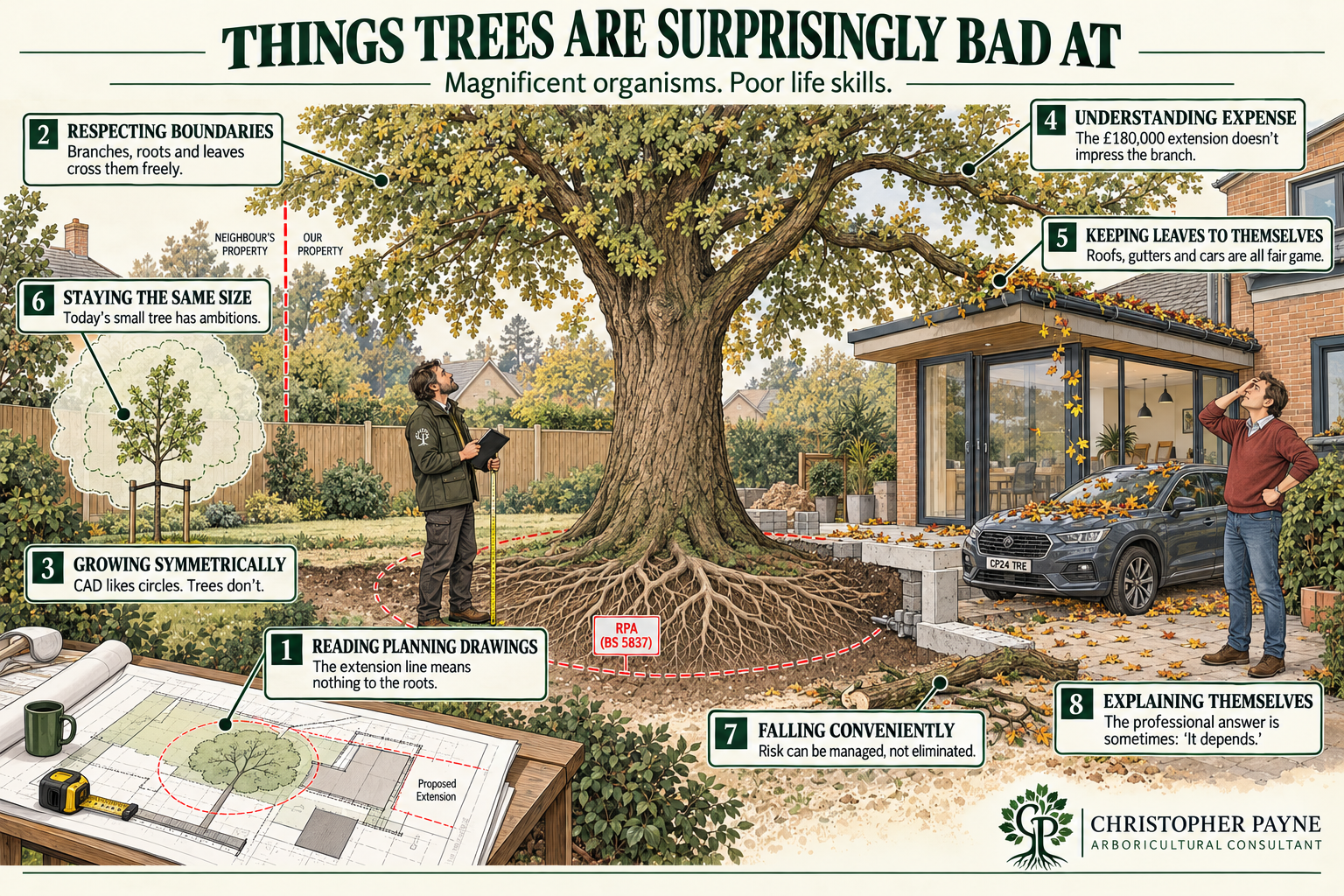
Trees are impressive organisms.
Unfortunately, after years of working with them, I have identified several serious deficiencies.
Reading planning drawings
This is perhaps their greatest failing.
You can produce a beautifully scaled drawing showing exactly where the extension will go.
The tree will continue growing as though the meeting never happened.
Worse still, its roots may already occupy the proposed construction area.
This is why arboricultural assessment needs to happen before the design becomes sacred.
Respecting ownership boundaries
Trees are equally poor at Land Registry plans.
Branches cross boundaries.
Roots cross boundaries.
Leaves cross boundaries with particular enthusiasm.
This can create complicated relationships between tree owners, neighbours and developers.
The tree remains largely indifferent to all of them.
Growing symmetrically
CAD loves circles.
Trees don’t.
A tree growing beside another tree, building or woodland edge may develop a strongly asymmetric crown.
This matters when assessing clearance, shading, pruning requirements and future relationships with buildings.
Drawing a generic green circle approximately where the tree stands is therefore not quite a tree survey.
Understanding that the extension was expensive
A tree has no concept of property values.
If a branch grows toward your £180,000 extension, it isn’t being unreasonable.
It is responding to light and growing space.
This is why future crown development needs considering before buildings are positioned.
Keeping their leaves to themselves
Deciduous trees have an unfortunate annual habit.
They drop leaves.
Often onto roofs, gardens, gutters and cars.
Some produce fruit.
Some produce seeds.
Some host aphids that produce honeydew.
None of these discoveries should come as a surprise after planning permission has been granted.
Trees behave remarkably like trees.
Remaining exactly the same size
Landscape drawings sometimes appear to assume trees reach planning submission and then stop.
They don’t.
Healthy trees continue growing.
A relationship that is comfortable today may become less comfortable later.
The same applies to new planting.
That adorable little tree shown beside the building may have ambitions.
Falling only when nobody is nearby
Trees are living structures exposed to wind, decay, drought and other environmental influences.
Occasional branch or whole-tree failure is inevitable.
Risk therefore needs managing proportionately, particularly where people or valuable property are exposed.
The objective isn’t to guarantee that trees never fail.
That guarantee is unavailable.
Explaining themselves
Perhaps most inconveniently, trees don’t tell us exactly what is happening.
We inspect.
Measure.
Observe.
Sometimes investigate.
Then make professional judgements from the available evidence.
Which explains why arboriculture occasionally produces an irritating answer:
“It depends.”
Not because arboriculturists are avoiding the question.
Because trees are surprisingly bad at providing simple answers.
Christopher Payne | Arboriculture Consultant