Article - The Tree Is Protected. That Doesn’t Mean It Has to Stay Forever.
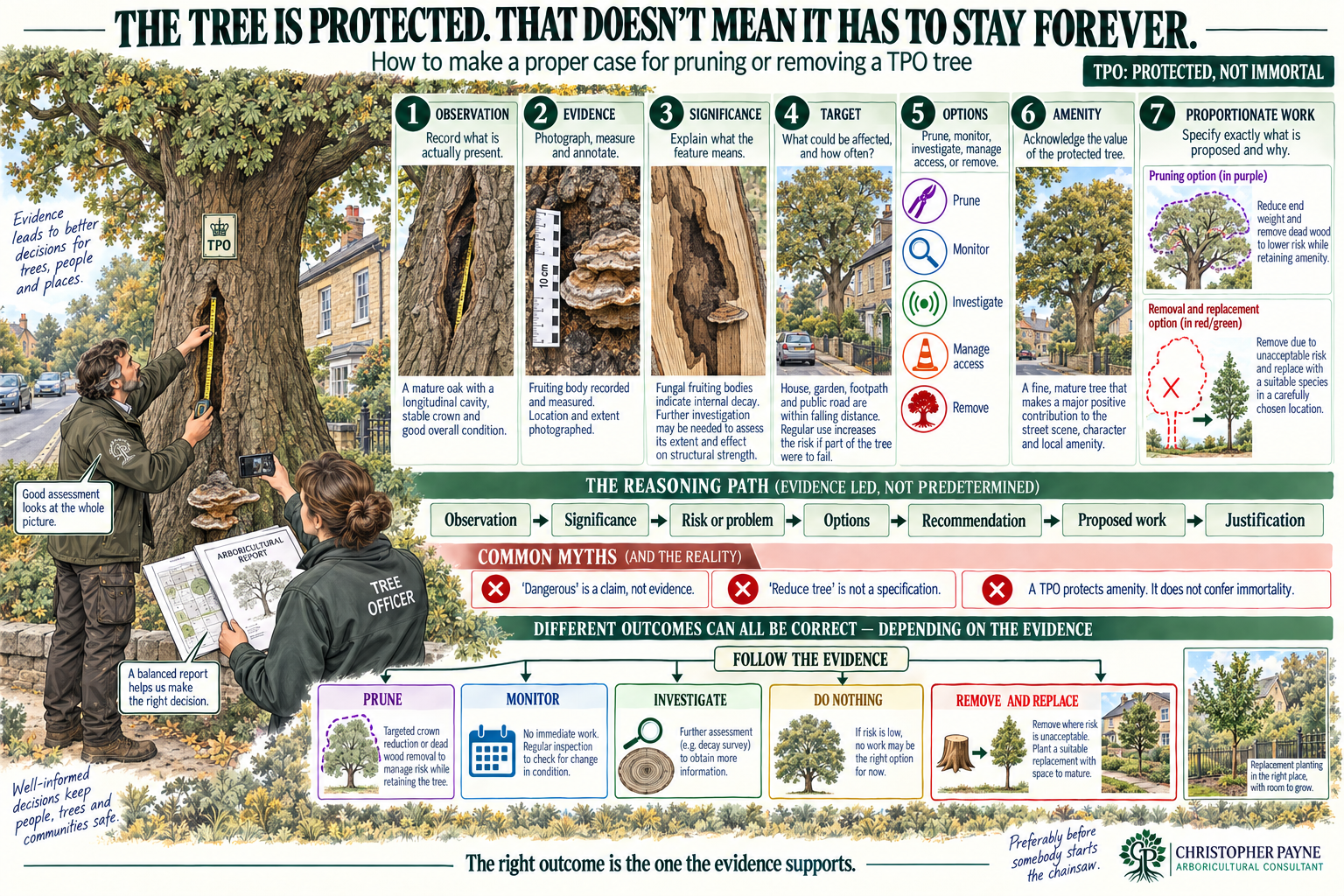
How to make a proper case for pruning or removing a TPO tree
There is a mature tree in the garden.
It is protected by a Tree Preservation Order.
The owner wants to remove it.
Somebody therefore says:
“You can’t. It’s got a TPO.”
This isn’t quite right.
A Tree Preservation Order protects a tree. It doesn’t confer immortality.
Protected trees can be pruned. They can sometimes be felled. Applications can be approved where the proposed work is properly justified.
The interesting question isn’t:
“Is the tree protected?”
We already know that.
The useful question is:
“Is there a sufficiently good reason for allowing the proposed work?”
That is where a good arboricultural report earns its keep.
“It’s dangerous”
This is probably one of the most frequently encountered reasons for wanting work to a tree.
Unfortunately, writing DANGEROUS TREE on an application form doesn’t make it so.
What is the defect?
Where is it?
How extensive is it?
What evidence indicates that it materially affects the tree or branch concerned?
What could be affected if failure occurred?
And, importantly, why does the defect justify the particular work being requested?
A cavity isn’t automatically a reason to fell a tree.
Neither is a fungal fruiting body.
Neither is a lean.
Neither is deadwood.
Neither is the fact that the tree moves when it is windy.
Trees are supposed to do some of these things.
Where tree condition or safety is being relied upon to justify work to a protected tree, appropriate arboricultural evidence may be required. Government guidance specifically anticipates supporting evidence where an application relies on tree health or safety. (GOV.UK)
The job of the report is therefore not to find frightening words.
It is to explain the significance of what has actually been observed.
Start with the tree, not the desired conclusion
There is a surprisingly important difference between these two instructions:
“Inspect this tree and tell me what you recommend.”
and:
“I need a report saying this tree should come down.”
The first requires professional judgement.
The second requires a printer.
A defensible report should begin with the evidence and reach a conclusion from it.
Sometimes that conclusion will support removal.
Sometimes pruning will provide an adequate and proportionate response.
Sometimes further investigation will be justified.
And occasionally the correct professional advice is:
“There isn’t a good arboricultural reason to do what you want to do.”
That can be an inconvenient answer.
It is still an answer.
Photographs are evidence. Use them properly.
A photograph of an entire 25-metre tree taken from the other side of the garden is excellent evidence that there is a tree.
We had probably already established that.
If the case depends upon a particular defect, photograph the defect.
Show its position.
Include context.
Where useful, include scale.
Annotate the photograph.
If there is a cavity, crack, fruiting body, included union, damaged root or localised area of dysfunction, make it possible for somebody reading the report to understand what you saw.
A good photograph can replace paragraphs of description.
A bad photograph can require paragraphs explaining what the reader is supposed to be looking at.
Measure things
“The cavity is quite large.”
How large?
“The crack is long.”
How long?
“The branch extends over the building.”
By approximately how much?
“The tree is close to the house.”
How close?
Arboricultural assessment inevitably contains professional judgement, but judgement becomes much more persuasive when attached to observations and measurements.
Numbers don’t eliminate judgement.
They give it something to stand on.
Fungi deserve slightly more than “fungus present”
A fungal fruiting body can be highly relevant.
But the mere existence of fungus isn’t a diagnosis of imminent structural failure.
Identification matters.
Host matters.
Location matters.
The decay strategy of the organism matters.
The distribution of fruiting bodies may matter.
The tree’s condition and adaptive growth matter.
And uncertainty matters too.
If identification isn’t secure, say so.
There is nothing professionally embarrassing about:
“The fruiting body is considered likely to be…”
There is considerably more wrong with confidently identifying the wrong fungus and building the entire recommendation around it.
Then consider the target
A structural defect in a tree growing beside a permanently occupied building presents a different management problem from the same defect in a tree standing in an inaccessible part of a large estate.
That doesn’t mean trees in low-use locations can’t fail.
It means risk involves consequences and exposure as well as the presence of a hazard.
This is where tree reports can go badly wrong.
They describe the defect beautifully and barely mention what the tree could actually hit.
The relationship matters.
Removal isn’t the only button
Suppose the assessment identifies a genuine concern.
Now ask the next question:
Does the whole tree need to go?
Perhaps a particular limb can be reduced.
Perhaps crown reduction could reduce loading while retaining the tree.
Perhaps deadwood management is sufficient.
Perhaps access beneath the tree can be altered.
Perhaps monitoring is reasonable.
Perhaps further investigation would materially reduce uncertainty.
Or perhaps none of those options adequately addresses the problem and removal really is the proportionate recommendation.
That last conclusion is much stronger after the alternatives have actually been considered.
A report supporting removal shouldn’t pretend alternatives don’t exist.
It should explain why they aren’t appropriate.
“It’s too big”
This is another favourite.
Too big for what?
The garden?
The owner’s preference?
Its structural capacity?
The available space?
The relationship with the building?
A large tree isn’t defective because it is large.
But size can contribute to a genuinely poor relationship.
Excessive shading, physical proximity, restricted use of space and foreseeable future conflicts can all be relevant circumstances.
If those matters form part of the case, describe them objectively.
“Tree too big” isn’t analysis.
A plan showing the relationship between a 20-metre tree, its crown and a dwelling can be.
Pruning applications need precision too
Suppose removal isn’t proposed.
The application says:
“Reduce tree.”
Excellent.
By how much?
Which parts?
To what dimensions?
For what reason?
The national guidance stresses that proposed work must be clearly specified, partly because the authority needs to understand exactly what it is being asked to approve and subsequently needs to know whether the consent has been exceeded. (GOV.UK)
A useful specification might identify the intended reduction in metres and resulting approximate dimensions, together with the purpose of the operation.
That gives the Tree Officer something definite to assess.
It also gives the contractor something definite to carry out.
Everyone benefits.
Especially the tree.
Don’t make the Tree Officer reconstruct your argument
Imagine receiving an application containing:
six unlabelled photographs;
a tree surgeon’s quotation;
the words “unsafe and overgrown”;
no measurements;
no assessment of alternatives;
and a request to fell a prominent protected tree.
Somewhere inside that material there might be a perfectly good case.
But somebody now has to discover it.
That isn’t the Tree Officer’s job.
The applicant is required to give reasons for the proposed work and, where applicable, provide appropriate supporting evidence. In determining the application, the authority considers both the tree’s amenity contribution and whether the proposed work is justified by the case advanced. (GOV.UK)
A good supporting report therefore does something very simple:
It joins the dots.
Observation.
Significance.
Risk or problem.
Options.
Recommendation.
Proposed work.
Justification.
The reader shouldn’t have to manufacture the missing connections.
Amenity cannot simply be ignored
There is another tree in the room.
The reason it has a TPO in the first place.
Protected trees are generally protected because of their public amenity value.
Consequently, a report seeking removal shouldn’t behave as though the tree’s value disappears because a defect has been discovered.
A mature prominent tree may have substantial amenity value and possess a defect that justifies removal.
Both things can be true simultaneously.
A balanced report acknowledges the loss.
Then explains why, despite that loss, the proposed work is justified.
That is much more convincing than trying to persuade everyone that a conspicuous 150-year-old tree is suddenly of no value whatsoever because the client wants it removed.
Replacement planting can strengthen the proposal
If removal is justified, what happens next?
For applications to remove protected trees, government guidance advises including proposals for replacement planting. (GOV.UK)
That shouldn’t be treated as an administrative afterthought.
A suitable replacement tree in a carefully chosen location may help address the long-term amenity consequences of removal.
Species matters.
Location matters.
Ultimate size matters.
Planting a tiny ornamental tree directly beside the stump of a substantial mature tree and declaring the landscape restored may be optimistic.
Replacement planting works best when somebody has actually thought about the next fifty years.
More pages do not make the argument stronger
A straightforward case may require a straightforward report.
A complicated veteran tree with suspected structural deterioration beside a heavily used area may require considerably more analysis.
The length should follow the problem.
Not the fee.
The purpose isn’t to overwhelm the Tree Officer with arboricultural vocabulary.
It is to provide enough reliable information for an informed decision to be made.
Sometimes that takes twenty pages.
Sometimes it takes five.
Sometimes one annotated photograph does more useful work than three pages explaining what the photograph would have shown if somebody had taken it.
And sometimes the answer really is removal
Arboriculture has occasionally suffered from the idea that retaining a tree is inherently the professionally superior recommendation.
It isn’t.
Trees decline.
Structural conditions change.
Their surroundings change.
Some become unsuitable for their locations.
Management options that were proportionate ten years ago may no longer be proportionate today.
There are circumstances in which retaining a protected tree requires increasingly elaborate interventions for diminishing benefit.
At some point the rational recommendation may be removal and replacement.
A TPO doesn’t prevent that conclusion.
It requires the conclusion to be properly considered.
The report should survive disagreement
This is perhaps the best test.
Imagine the Tree Officer disagrees with you.
Could another arboriculturist read the report and understand exactly how you reached your conclusion?
Could a Planning Inspector understand the argument if a refusal subsequently went to appeal? There is a formal appeal route against refusal of consent or conditions imposed on TPO works. (GOV.UK)
They don’t have to agree with every judgement.
Professional opinions legitimately differ.
But they should be able to follow the reasoning.
That is what makes a report defensible.
So how do you get permission to remove a protected tree?
There is no magic sentence.
Not:
“Dangerous.”
Not:
“Diseased.”
Not:
“Too close to house.”
And definitely not:
“Client concerned.”
Inspect it properly.
Identify the relevant features.
Record the evidence.
Explain their significance.
Consider the tree’s surroundings and amenity.
Consider reasonable alternatives.
Specify the proposed work precisely.
Then explain why that work represents a proportionate arboricultural response.
Sometimes the answer will be pruning.
Sometimes monitoring.
Sometimes further investigation.
Sometimes doing nothing.
And sometimes the evidence leads perfectly reasonably to:
Remove tree and replace.
A Tree Preservation Order doesn’t make that conclusion impossible.
It simply means you need to make the case.
Preferably before somebody starts the chainsaw.
Christopher Payne | Arboriculture Consultant