Article - What Could Possibly Go Wrong?
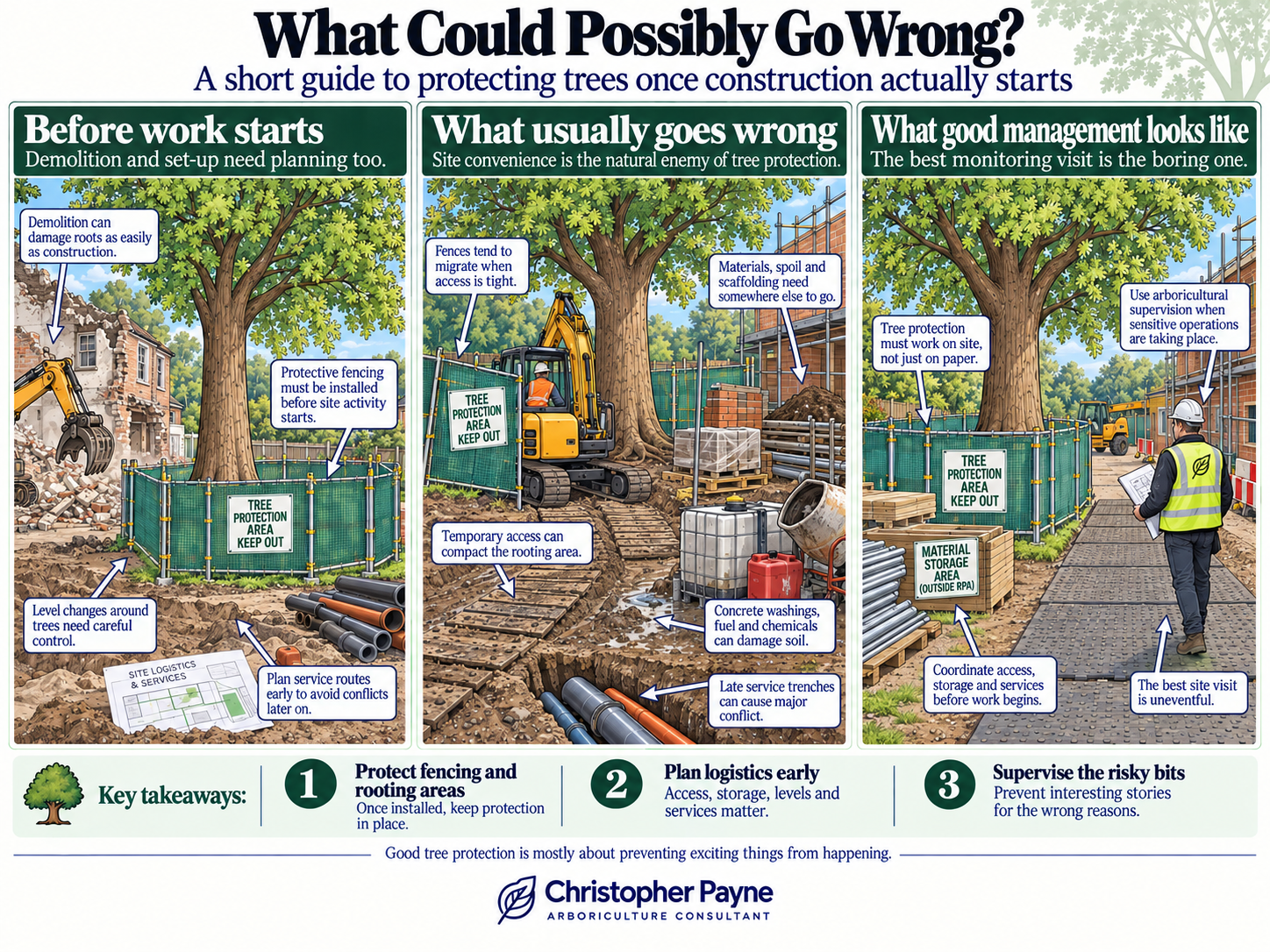
What Could Possibly Go Wrong?
A short guide to protecting trees once construction actually starts
The planning permission has been granted.
The Arboricultural Method Statement has been approved.
The Tree Protection Plan contains coloured lines.
Protective fencing is installed.
What could possibly go wrong?
Quite a lot, as it happens.
Demolition
Demolition is essentially construction’s more enthusiastic sibling.
Buildings disappear.
Concrete breaks.
Machinery moves around.
Materials need storing.
Ground gets disturbed.
If retained trees stand nearby, demolition needs just as much thought as construction.
A root doesn’t particularly care whether the excavator damaging it is building something or knocking something down.
The disappearing fence
Protective fencing has a curious natural predator.
It is called site convenience.
The fence starts in the correct location.
Then a delivery arrives.
Someone needs another metre.
The fence moves.
Then the excavator needs access.
It moves again.
Eventually it has migrated beneath the tree it was intended to protect.
A realistic Tree Protection Plan considers how the site will actually operate.
Otherwise the fence is merely an aspiration drawn in green.
“We’ll only be there for ten minutes”
Compaction doesn’t operate a stopwatch.
Heavy machinery passing over rooting areas can alter soil structure.
Repeated vehicle movements are particularly problematic.
This is why temporary access routes matter.
The fact that something is temporary doesn’t mean its effects are.
Materials need somewhere to live
Bricks.
Soil.
Scaffolding.
Pipes.
Pallets.
Spoil.
Skips.
Every construction site generates things that require space.
If nobody decides where they go, the conveniently empty area behind the tree protection fence becomes surprisingly attractive.
Construction logistics and tree protection are therefore closely related.
Concrete is not tree food
Nor are cement washings, fuel, oils and various other substances found on construction sites.
Tree protection isn’t simply about preventing mechanical root damage.
Changes to soil chemistry can also matter.
The protected area should actually be protected.
The clue is in the name.
Levels
Few things on a drawing look more innocent than a contour.
Changing ground levels around retained trees can affect roots and the soil environment.
Excavation removes roots.
Raising levels can alter aeration, drainage and soil conditions.
Proposed levels therefore deserve attention before somebody decides to “just tidy this bit up”.
Services arrive late to the party
The building is nearly finished.
Then somebody remembers broadband.
Or lighting.
Or drainage.
A trench appears.
Unfortunately, the route passes directly through the protected rooting area.
This is why service coordination belongs at design stage, not in the final fortnight of construction.
Arboricultural supervision
Does every operation beside every tree require an arboriculturist standing there?
No.
That would be expensive and extremely boring.
Supervision is useful where particular operations carry significant arboricultural risk or where decisions may need to be made in response to conditions discovered on site.
The objective is targeted intervention.
Be there when it matters.
The best site visit is uneventful
A successful arboricultural monitoring visit is deeply disappointing television.
The fencing is where it should be.
The ground is undisturbed.
The specialist construction has been installed correctly.
Nobody has excavated anything surprising.
Photographs are taken.
Everyone goes home.
Perfect.
Good tree protection is mostly about preventing exciting things from happening.
Because in arboriculture, “you should have seen what the excavator did” rarely introduces a happy story.
Christopher Payne | Arboriculture Consultant