Article - Building driveways and hard surfaces near trees
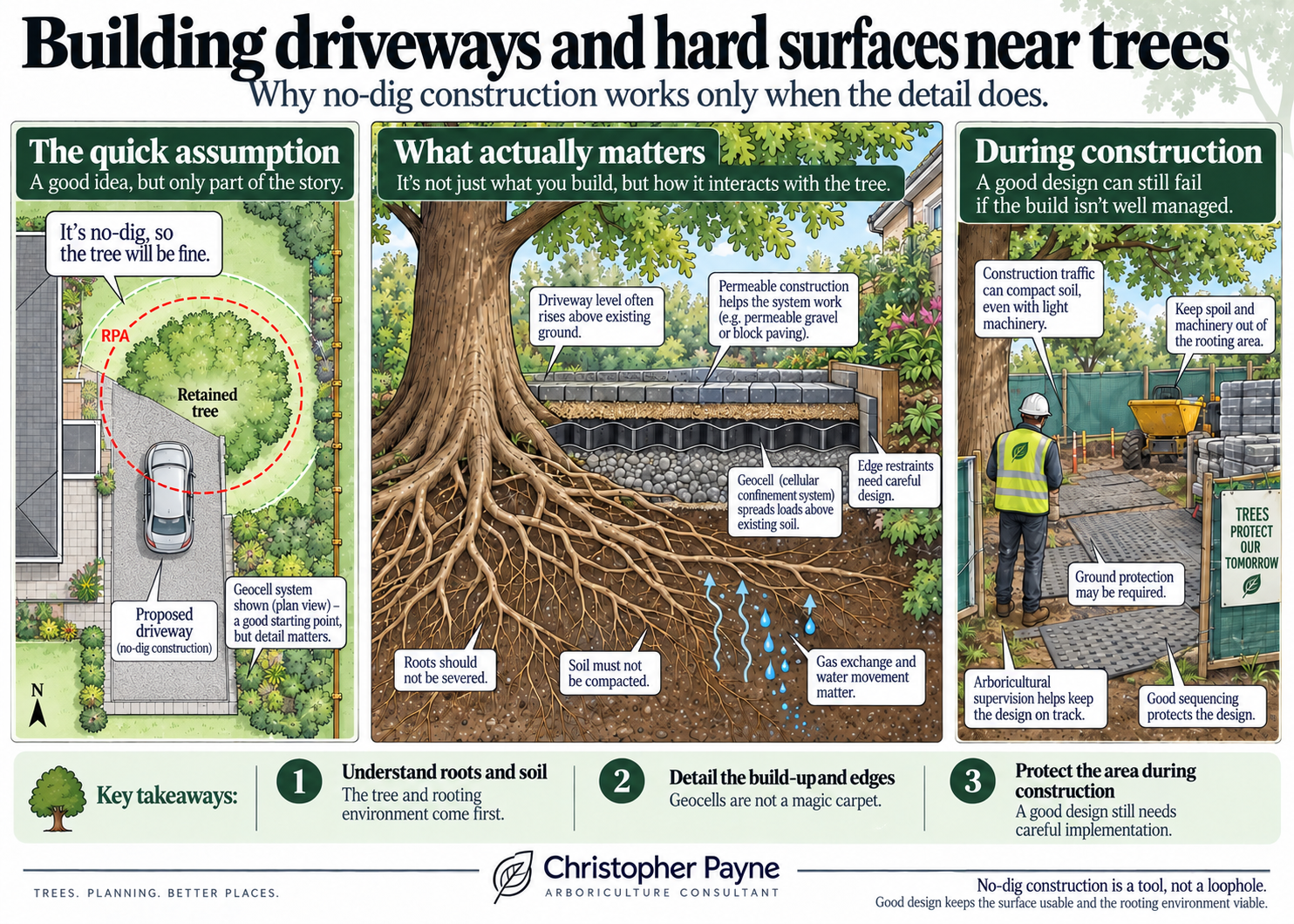
Building driveways and hard surfaces near trees
There is a phrase capable of causing an arboriculturist mild anxiety when it appears on a drawing:
“No-dig construction.”
Sometimes it describes a carefully engineered solution designed around the rooting environment of a retained tree.
Sometimes it appears to mean:
“We’re putting some plastic cells on the ground, so presumably the tree will be fine.”
These are not the same thing.
No-dig construction can be an excellent way of creating driveways, parking areas and other hard surfaces close to retained trees. But it works because of some fairly straightforward engineering and arboricultural principles, not because the words no-dig have protective properties.
Why conventional driveway construction can be a problem
A typical hard surface needs a stable foundation.
Conventionally that often means excavating existing soil, installing a sub-base and compacting it until it is capable of carrying the intended loads.
Perfectly sensible engineering.
Potentially terrible arboriculture.
Tree roots are frequently concentrated within the upper layers of soil. Excavation may sever them directly, while repeated trafficking and compaction can damage the soil they depend upon.
That matters because roots need more than something brown to grow through.
A functioning rooting environment needs an appropriate balance of soil structure, moisture and gases. Roots respire. Oxygen has to reach them and carbon dioxide has to escape.
Turn decent rooting soil into something with the physical characteristics of a motorway sub-base and the tree may object.
Admittedly, it won’t object immediately.
Trees are inconveniently slow complainants.
So what does “no-dig” actually mean?
The basic principle is to construct the surface above the existing soil rather than excavating down through it.
The Arboricultural Association’s guidance on cellular confinement systems identifies three fundamental principles:
roots should not be severed;
soil should not be compacted; and
gas exchange within the soil should be maintained.
That sounds simple.
Achieving it while simultaneously producing a driveway capable of supporting vehicles is where things become more interesting.
Cellular confinement systems
One solution is a cellular confinement system, often referred to generically as a geocell.
Imagine a three-dimensional honeycomb laid across the existing ground.
The cells are expanded, secured and filled with suitable material. When properly designed, the system spreads loads across a wider area and helps reduce the pressure transmitted to the underlying soil.
Rather than excavating perhaps several hundred millimetres of soil and replacing it with conventional compacted construction, much of the structural build-up occurs above existing ground level.
From an arboricultural perspective, that can be extremely useful.
But the important words are “properly designed.”
A geocell is not a magic carpet.
Thickness matters
A system that is suitable for a garden path is not automatically suitable for a driveway.
A driveway used occasionally by a small car is not necessarily the same engineering problem as an access regularly used by refuse vehicles, delivery lorries or fire appliances.
The required construction depends on the loads it needs to carry, the ground conditions and the characteristics of the confinement system.
This sounds obvious.
Yet “install geocell within RPA” occasionally appears on plans as though that constitutes a full engineering specification.
It does not.
That is roughly equivalent to specifying a bridge by writing:
“Use steel.”
Technically relevant. Some detail still required.
Ground levels matter too
One of the advantages of no-dig construction is also one of its complications.
If you don’t excavate, the new surface generally goes upwards.
That change in level has to go somewhere.
Imagine a driveway that rises 200 mm above surrounding ground.
What happens at the edges?
A conventional solution might involve excavating for kerbs or concrete haunching.
Unfortunately, excavating a trench around an otherwise beautifully designed no-dig driveway rather defeats the point.
Edge restraints therefore need careful thought.
The same applies where the new surface meets a highway, garage threshold, existing paving or drainage channel.
No-dig design is not simply a question of what happens in the middle of the driveway.
The edges are often where the difficult details live.
And then there is water
Trees generally prefer rainfall to remain capable of reaching the soil.
Covering rooting areas with an impermeable surface can change both water infiltration and soil aeration.
For this reason, permeable construction is commonly an important part of hard-surface design near trees.
But again, saying “permeable paving” is not the end of the conversation.
The entire construction build-up needs to work.
A permeable block laid over an impermeable layer is a little like fitting an opening window to a brick wall.
The component works beautifully.
The system does not.
Drainage also needs considering beyond the footprint of the surface. Changes in levels and runoff can redirect water elsewhere on the site, sometimes toward buildings and occasionally away from the tree you were trying to protect.
What about existing roots at the surface?
This is where site-specific assessment becomes important.
A drawing might show perfectly level ground.
The tree may have other ideas.
Surface roots, buttress roots and local ground irregularities can make construction considerably more complicated.
Simply cutting off inconvenient roots to make the geocell sit flat would be an admirably efficient way of defeating the entire purpose of using a no-dig system.
Sometimes small adjustments in level can accommodate roots.
Sometimes local bridging or changes in construction are possible.
Sometimes the proposed layout needs changing.
And occasionally the sensible conclusion is that the location is unsuitable for the intended hard surface.
Good arboricultural advice occasionally consists of explaining why an ingenious technical solution should not be used.
Preparation of the ground is not necessarily zero intervention
“No-dig” can sound as though nobody is permitted to touch the ground.
That isn’t quite the point.
Limited removal of vegetation or very shallow surface material may sometimes be appropriate, depending on conditions and the specification being followed.
But there is an important difference between careful surface preparation and excavating a conventional foundation.
The Arboricultural Association’s guidance specifically recognises that obvious surface roots and shallow soils may require even greater restraint.
This is also why arboricultural supervision may be appropriate during sensitive preparation work.
There is a considerable difference between:
“Remove loose vegetation carefully and stop if roots are exposed”
and:
“Dave, can you just scrape another 100 mm off that?”
Many tree problems begin with the word “just.”
Construction traffic can ruin a good design before it is built
Suppose we have designed an excellent no-dig driveway.
The levels work.
The cellular confinement system is correctly specified.
The surface is permeable.
The edges avoid excavation.
Everything is wonderful.
Then, before installation, a 14-tonne excavator spends a week driving backwards and forwards over the proposed route.
We now have an excellent design for protecting some thoroughly compacted soil.
Temporary ground protection and construction sequencing therefore matter.
The rooting environment has to survive the construction process, not merely the final drawing.
Where access through an RPA is unavoidable, the protection required depends on factors such as existing ground conditions, anticipated loads, frequency of vehicle movements and duration of use.
Again, engineering and arboriculture meet.
They usually get on rather well when introduced early enough.
Sometimes the best solution is moving the driveway
Technical solutions are useful.
They should not become an excuse for poor design.
If moving a driveway one metre removes most of the conflict with an important tree, that is often better than designing an elaborate engineered solution simply because the original line looked attractive on the architect’s drawing.
This is one reason arboricultural input is most useful early in the design process.
Moving a line on CAD takes seconds.
Moving a completed driveway takes rather longer.
The detail belongs on the drawing
If specialist hard surfacing is required around retained trees, the construction detail should be clear enough that somebody can actually build it.
That may include:
the extent of the specialist construction;
existing and proposed levels;
cellular confinement depth and specification;
fill material;
separation or reinforcing layers;
surface finish;
edge restraints;
drainage arrangements;
transitions into conventional construction;
tree protection requirements; and
any stages requiring arboricultural supervision.
The important point is that the Tree Protection Plan, Arboricultural Method Statement and engineering details should tell the same story.
A planning condition is not the ideal place to discover that the architect, engineer and arboriculturist have designed three different driveways.
No-dig construction is a tool, not a loophole
Used correctly, specialist construction can allow development and worthwhile trees to coexist where conventional methods might cause unacceptable damage.
That can make the difference between removing a mature tree and designing intelligently around it.
But the objective is not simply to satisfy a coloured circle on a planning drawing.
The objective is to create a usable surface while retaining a viable rooting environment beneath it.
That requires understanding the tree, the soil, the levels, the loads and the construction process.
So when somebody says:
“Don’t worry, it’s no-dig.”
The correct response is probably:
“Excellent. Show me the detail.”
Christopher Payne | Arboriculture Consultant