Article - It’s Only a Tree: Until You Try to Build Next to It
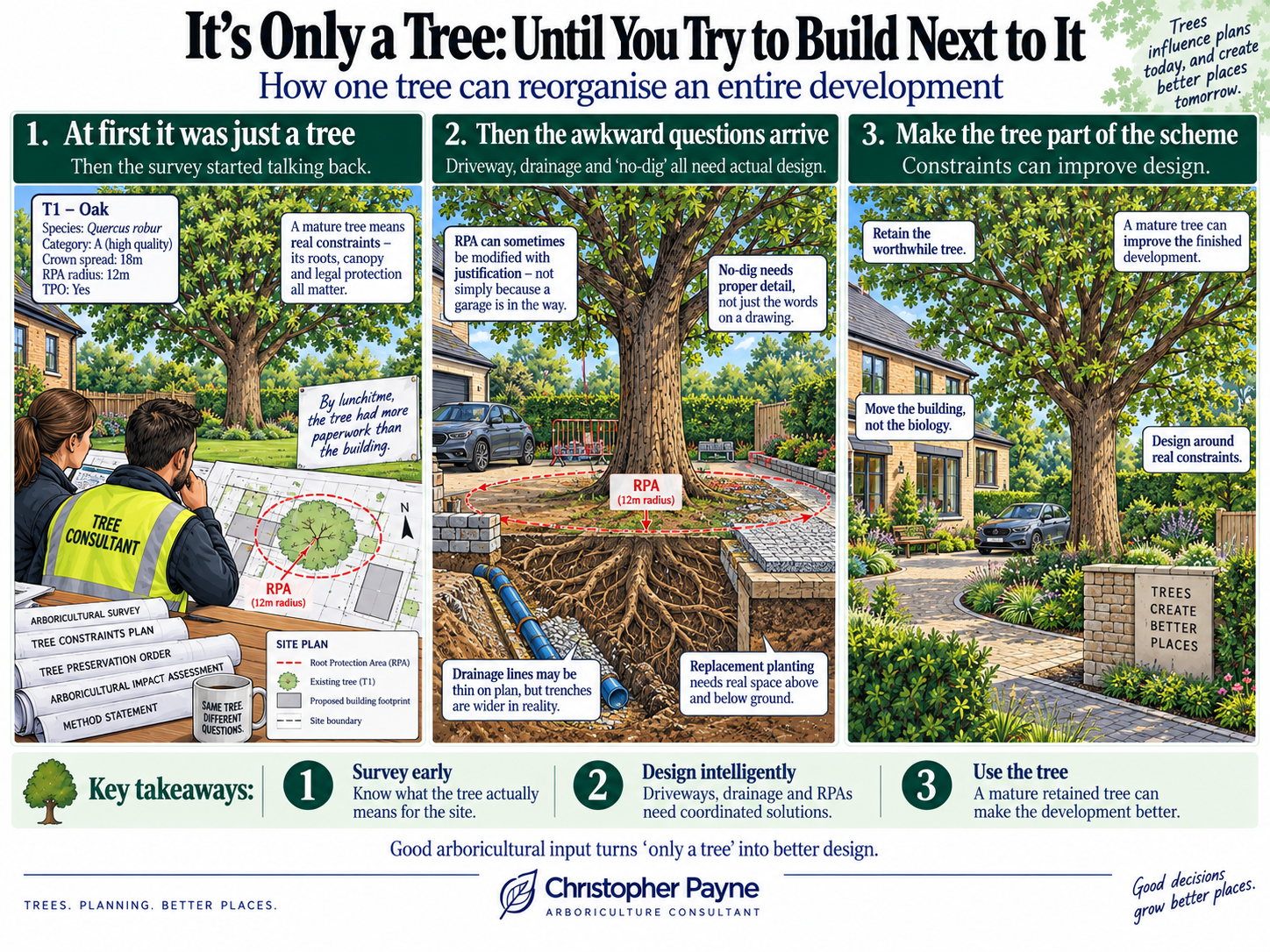
It’s Only a Tree: Until You Try to Build Next to It
How one tree can reorganise an entire development
At the first design meeting, the tree wasn’t considered a problem.
It was just a tree.
A reasonably attractive mature oak near the edge of the site. Plenty of room around it. Nothing to worry about.
Then somebody commissioned a tree survey.
This is where things started to deteriorate.
The tree acquired a number.
Then a category.
Then a crown spread.
Then a Root Protection Area.
Someone discovered it was protected by a Tree Preservation Order.
By lunchtime, the tree had more paperwork than the building.
Welcome to development around trees.
“Can’t we just move the RPA?”
Sometimes.
But not because it is inconvenient.
The Root Protection Area calculated under BS 5837 is a starting point for identifying the rooting environment that needs consideration if a tree is to be retained.
Real roots don’t grow as geometrically perfect circles.
Their distribution responds to soil, structures, previous disturbance, moisture, topography and other site conditions.
There can therefore be legitimate reasons for modifying the shape of an RPA.
“There is a garage in the way” isn’t one of them.
“Can’t we just put the driveway through it?”
Possibly.
Now we have a useful question.
Development around trees isn’t necessarily about creating an exclusion zone and surrendering everything inside it to nature.
Sometimes carefully designed construction can take place within rooting areas.
A driveway might use an appropriate no-dig construction rather than conventional excavation.
Its design might incorporate load distribution, cellular confinement and a permeable surface.
Or the driveway might simply be moved.
The correct solution depends upon the tree, ground conditions, levels, intended loading and extent of the incursion.
The important word is designed.
“No-dig” written beside a driveway on a planning drawing isn’t actually a construction specification.
“What about the drainage?”
Ah.
The drainage.
It is remarkable how often beautiful development layouts reach an advanced stage before somebody remembers that water and sewage have to leave the buildings.
Suddenly a perfectly innocent-looking line crosses the tree’s RPA.
Unfortunately, the actual trench may be considerably wider than the line.
Now we need to consider alternative routes, existing service corridors, installation methods and potentially trenchless techniques.
Again, much easier on a computer than with an excavator already sitting on site.
“We’ll plant another tree.”
Excellent.
Where?
There is a curious tendency for proposed replacement trees to inhabit areas that simultaneously contain parking spaces, visibility splays, drainage, lighting columns and underground services.
Trees require space above and below ground.
If replacement planting matters to the scheme, it needs to be designed as infrastructure rather than sprinkled onto the landscape plan immediately before submission.
The interesting bit
Now suppose we change the question.
Instead of asking:
How can we squeeze this development past the oak?
we ask:
How can the oak become part of the development?
Move the building.
Alter the parking arrangement.
Change the drainage route.
Give the tree meaningful space.
Put windows where occupants can actually enjoy looking at it.
Design the landscape around it.
Suddenly the tree isn’t merely an obstruction.
It is a mature landscape feature that the developer didn’t have to wait 50 years to grow.
Constraints can improve design
Good arboricultural input isn’t about finding reasons development can’t happen.
It is about identifying the genuine constraints early enough for the design to respond intelligently.
Some trees should be retained.
Some can reasonably be removed.
Some apparent conflicts can be engineered away.
Others can’t.
The expensive mistake is discovering which is which after everybody has finished designing the scheme.
So yes, sometimes it really is “only a tree”.
Right up until somebody tries to build next to it.
Then things get interesting.
Christopher Payne | Arboriculture Consultant