Article - We’ll Plant Three New Ones
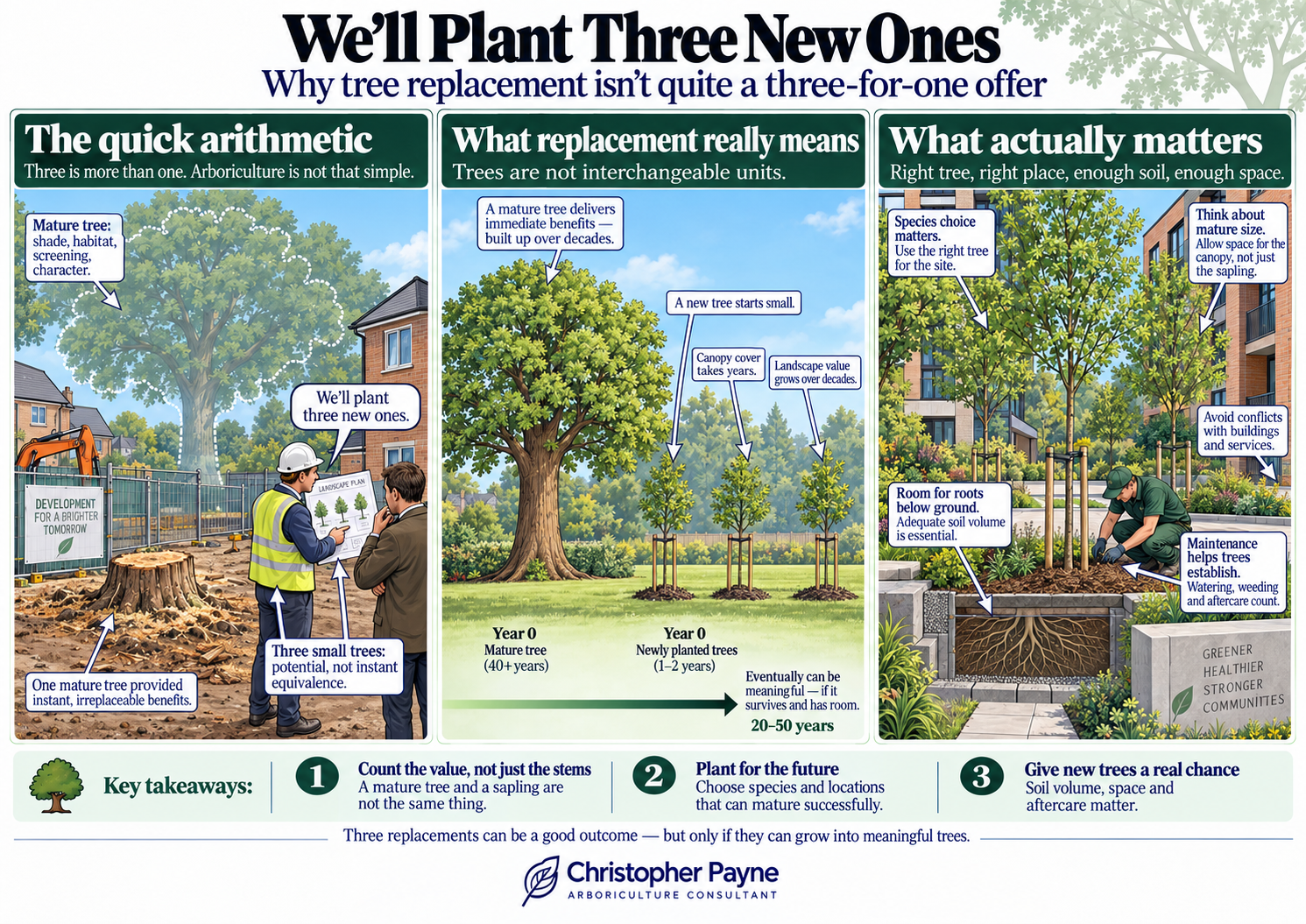
We’ll Plant Three New Ones
Why tree replacement isn’t quite a three-for-one offer
The development requires removal of a mature tree.
Someone looks at the landscape plan and offers the solution:
“We’ll plant three new ones.”
Excellent.
Three is larger than one.
Mathematically, the matter appears settled.
Arboriculturally, we may need another few minutes.
Trees aren’t interchangeable units
A mature tree and a newly planted tree are both trees in roughly the same sense that a cottage and a pile of bricks are both buildings.
The potential is there.
The timescale is different.
A mature tree may already provide substantial canopy cover, landscape character, shade, habitat and visual screening.
A young replacement begins its contribution at a much smaller scale.
It may eventually become a large mature tree.
That is precisely why planting it can be worthwhile.
But the word eventually is doing some work.
Quantity isn’t everything
Five badly chosen trees planted in inadequate spaces aren’t necessarily better than two well-selected trees given sufficient room to develop.
Successful planting involves species selection, available rooting volume, soil conditions, drainage, future size, proximity to buildings, services, highways and long-term management.
This produces another useful question:
What do we actually want these trees to become?
If the answer is substantial landscape trees, they need somewhere capable of supporting substantial landscape trees.
The tiny green circles
Landscape plans have a charming habit of depicting proposed trees as identical little green circles.
Reality is less orderly.
A birch, oak, hornbeam and ornamental cherry won’t mature into interchangeable objects.
Their dimensions, form, longevity and site requirements differ.
Species selection therefore needs to relate to the space available and the purpose of planting.
Right tree, right place is an old phrase because it remains stubbornly useful.
Please don’t plant the future problem
Planting a large-growing tree two metres from somebody’s living-room window creates a predictable sequence.
Year 1: lovely new tree.
Year 10: getting quite substantial.
Year 20: “This tree is too close to the house.”
Year 25: application to remove tree.
We can do better than this.
Good replacement planting considers mature dimensions from the beginning.
Underground matters too
A tree may have plenty of apparent space on a landscape plan while its proposed rooting environment contains utilities, engineered sub-base and compacted construction ground.
This is especially important in heavily engineered developments.
Trees need usable soil volume.
Where conventional planting space is limited, purpose-designed tree pits, connected soil volumes or engineered rooting systems may sometimes provide solutions.
Again, design matters.
Replacement planting can be better
None of this is an argument against removing trees.
Sometimes removal is entirely justified.
A development may remove several mediocre trees and create an opportunity for better species, better locations and a coherent long-term landscape.
That can be a good arboricultural outcome.
The objective shouldn’t always be to preserve every existing stem indefinitely.
It should be to understand what is being lost and ensure that what replaces it has a realistic prospect of making a meaningful contribution.
So will three new trees replace one old one?
Perhaps.
Eventually.
If they survive.
If they’re appropriate species.
If they’re planted properly.
If they have enough soil.
If nobody parks on them.
If they’re maintained.
If they’re given enough room to mature.
Suddenly our three-for-one offer has acquired terms and conditions.
Which is why good tree planting starts with considerably more than the number three.
Christopher Payne | Arboriculture Consultant