Article - Arboricultural Translation Service
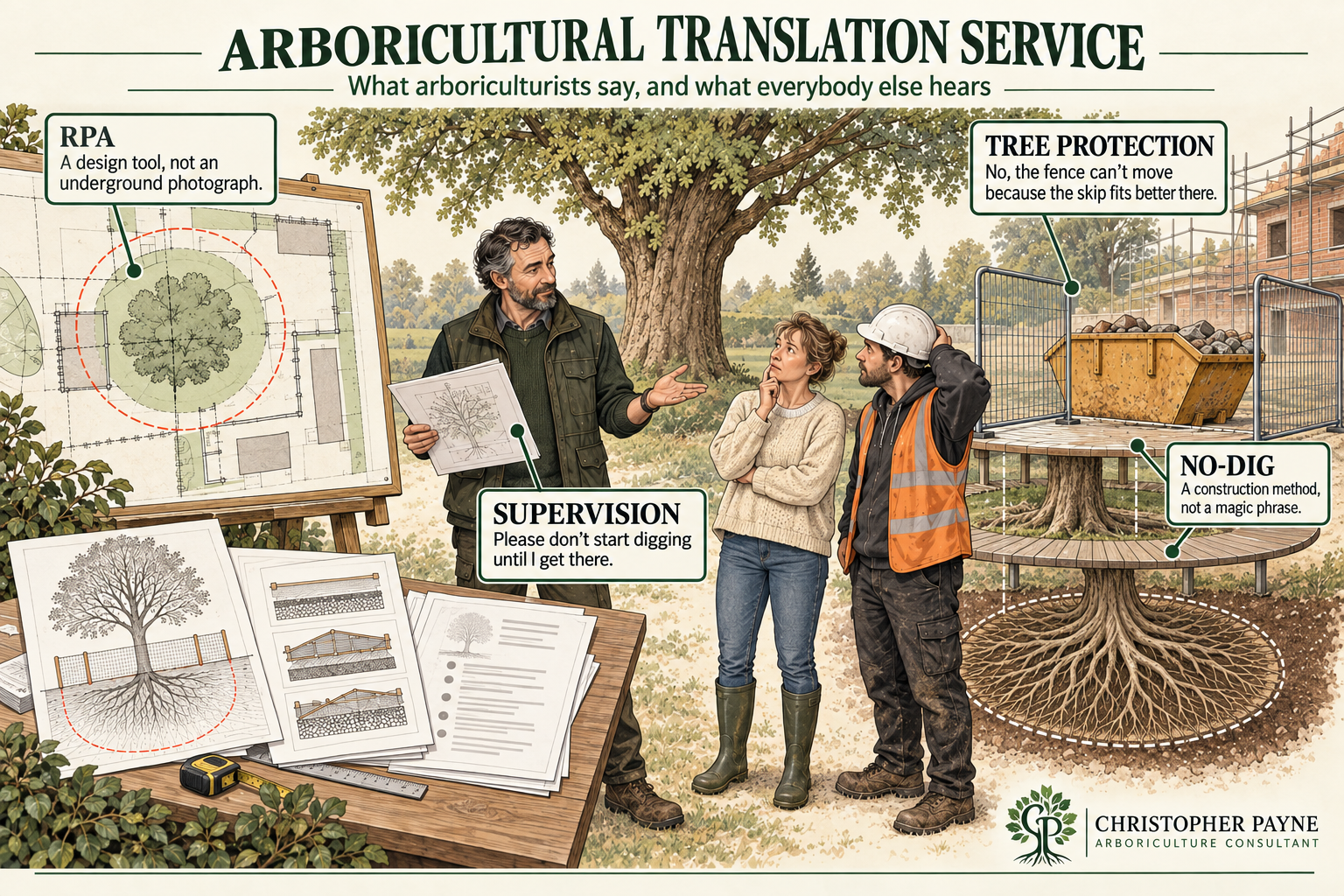
What arboriculturists say, and what everybody else hears
Arboriculture has its own language.
This is useful when arboriculturists talk to one another.
It becomes slightly less useful when a homeowner receives a report containing RPAs, CEZs, AMSs and references to “arboricultural supervision during sensitive operations”.
So, as a public service, here is a translation.
“Root Protection Area”
What it sounds like:
A mathematically perfect circle containing all the tree’s roots.
What it actually means:
An area calculated using BS 5837 methodology as a starting point for protecting the rooting environment of a retained tree.
Roots haven’t seen the circle.
They may extend beyond it, be sparse within parts of it, or have been influenced by buildings, roads, soil conditions and previous disturbance.
The circle is a design tool, not an underground photograph.
“Minor RPA incursion”
Translation:
“We would like to build where some roots may be.”
This isn’t necessarily disastrous.
The important questions are how much of the RPA is affected, where, what already occupies the ground, what construction is proposed and whether the tree can tolerate the impact.
A percentage alone doesn’t answer all of those questions.
“No-dig construction”
What some people hear:
“Excellent. We can build whatever we like over the roots.”
Actual translation:
“We may be able to construct something without conventional excavation, provided somebody actually designs it.”
No-dig isn’t a magic phrase.
Levels, loading, soil conditions, permeability, edge restraints and installation all matter.
“Arboricultural supervision required”
Translation:
“Please don’t start digging until I get there.”
This normally applies where an operation close to a tree could encounter roots or otherwise requires decisions to be made as work proceeds.
It doesn’t mean an arboriculturist needs to watch somebody build the entire house.
That would be expensive for the client and extraordinarily tedious for the arboriculturist.
“Protective barrier to remain in situ”
Translation:
“No, you can’t move the fence because the skip fits better there.”
Tree protection fencing works remarkably well while it remains where it was designed to be.
Its effectiveness decreases sharply after being dismantled and stacked beside the site hut.
“Arboricultural Method Statement”
What it shouldn’t mean:
Twenty pages of generic text that nobody on site will ever read.
What it should mean:
Clear instructions explaining how potentially damaging operations around retained trees will actually be carried out.
If the person operating the excavator cannot work out what applies to them, something has gone wrong.
“Future pressure for tree removal”
Translation:
“We’ve designed a completely predictable argument for somebody to have in fifteen years.”
Putting a large tree immediately beside a small garden or principal window may be physically possible.
Whether future occupants will tolerate it is another question.
“Replacement planting”
Translation:
“The development removes trees, so let’s make sure what comes afterwards is actually worth having.”
It doesn’t mean scattering tiny ornamental trees around whatever pieces of ground remain after everything else has been designed.
Good planting needs space.
“Arboricultural constraints”
And finally:
What some clients hear:
“Reasons you can’t build.”
What it should mean:
“Things we need to understand so we can work out how you can build.”
That is a much more useful translation.
Christopher Payne | Arboriculture Consultant