Article - Tree Surveys: More Than Counting Trees
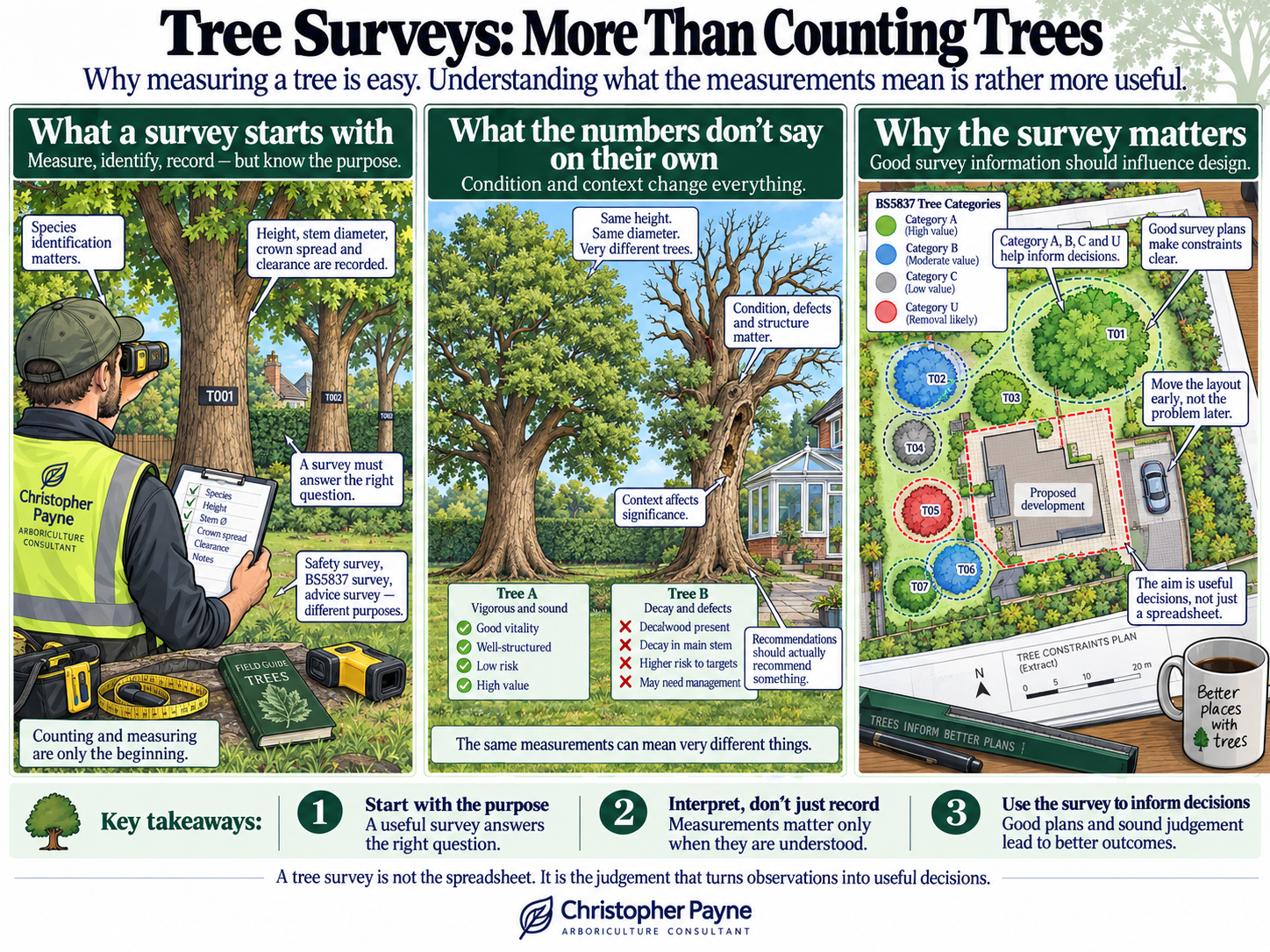
Why measuring a tree is easy. Understanding what the measurements mean is rather more useful.
At first glance, a tree survey sounds straightforward.
Find tree.
Identify tree.
Measure tree.
Write numbers down.
Move to next tree.
Repeat until lunch.
And, at the most basic level, that is indeed part of the job.
Unfortunately, a spreadsheet containing the heights and diameters of 47 trees isn’t necessarily a useful tree survey. It may simply be an extremely accurate description of 47 trees.
The real value of a professional tree survey lies in what happens to the information afterwards.
First, what sort of tree survey?
“Can you do a tree survey?” is rather like asking, “Can you inspect my building?”
Probably.
But why?
Tree surveys are undertaken for very different purposes.
A landowner may need a safety survey.
A developer may need a BS 5837 survey to support a planning application.
A homeowner may want advice about a suspicious-looking tree.
An architect may need accurate tree constraints before designing a development.
A school, church or local authority may need a systematic inspection of a large tree population.
The trees may be exactly the same.
The questions being asked of them are not.
A useful survey therefore starts by establishing its purpose.
Otherwise, there is a genuine risk of producing a beautifully presented answer to the wrong question.
The tape measure isn’t the clever bit
Tree surveys involve plenty of measurement.
Stem diameter. Height. Crown spread. Crown clearance. Sometimes distances to buildings or other features.
None of this is particularly mysterious.
Give two competent surveyors the same tree and their measurements should be reasonably similar.
The interesting differences tend to appear when they are asked:
What does this information mean?
Consider two mature oak trees, both 20 metres tall and both with a stem diameter of 900 mm.
On a spreadsheet they may initially look remarkably similar.
But one could be a vigorous, structurally sound tree with substantial landscape value and the potential to remain for many decades.
The other might have extensive basal decay, a compromised structure, significant deadwood and a particularly intimate relationship with someone’s conservatory.
Same species.
Same height.
Same diameter.
Very different trees.
This is why arboriculture stubbornly refuses to become an exercise in data collection.
Identifying the tree helps
Knowing what species you are looking at is useful.
Trees differ enormously in growth habit, mature size, longevity, rooting characteristics, susceptibility to particular pests and diseases, response to pruning and tolerance of environmental change.
A 12-metre birch and a 12-metre cedar aren’t interchangeable simply because the laser rangefinder produced the same number.
Species identification also occasionally provides entertainment.
Some trees present themselves with the botanical equivalent of a passport.
Others hybridise, vary, lose all their leaves at inconvenient times or have been planted as obscure cultivars by somebody who clearly wanted future arboricultural consultants to suffer.
Fortunately, absolute taxonomic perfection is rarely the point.
The important thing is understanding the tree well enough to make sound decisions about it.
Condition matters, but context matters too
A tree survey normally records aspects of physiological and structural condition.
Is the crown vigorous?
Is there significant deadwood?
Are there cavities?
Cracks?
Weak unions?
Fungal fruiting bodies?
Previous failures?
Evidence of decay?
Has somebody pruned it in a manner suggesting a long-standing disagreement with trees?
These observations matter.
But their significance depends on context.
A defective branch above an inaccessible corner of a woodland isn’t equivalent to the same branch above a busy playground.
Likewise, a hollow veteran tree isn’t automatically a “dangerous tree”.
Hollowing and decay are natural processes in old trees and can provide extremely valuable habitat. A tree can contain extensive decay and remain standing for a very long time.
The job isn’t to discover imperfection and prescribe a chainsaw.
It is to understand the defect, the tree’s response to it, the likelihood and consequences of failure, and what proportionate management, if any, is justified.
Trees are living structures.
They don’t come with an MOT pass or fail certificate.
Then somebody mentions BS 5837
Tree surveys for development have another purpose.
Here the question isn’t simply:
“Is this tree safe?”
It is also:
“What does this tree mean for the proposed development?”
BS 5837 surveys record information that helps assess trees in relation to design, demolition and construction.
Trees are evaluated according to their quality and value, with categories used to help inform decisions about retention and removal.
This is where coloured tree survey plans appear.
Category A.
Category B.
Category C.
Category U.
To the uninitiated, it can look suspiciously like arboricultural traffic lights.
It isn’t.
The categories help distinguish trees of differing quality and value so that better trees can exert an appropriate influence on design.
A Category C tree isn’t automatically worthless.
A Category A tree isn’t automatically untouchable.
And a Category U tree doesn’t spontaneously explode when approached by an architect.
The categories are decision-making tools.
Professional judgement is still required.
A good survey should influence the design
This is perhaps the most important part.
If a tree survey is commissioned after the buildings, roads, parking spaces, drainage and gardens have already been designed, an opportunity has been missed.
The survey should ideally inform the design process.
It identifies where important trees are located.
It establishes their dimensions.
It indicates their likely constraints.
It helps distinguish trees worth designing around from those whose removal may be reasonable.
That allows the design team to ask useful questions early.
Could the building move slightly?
Could access come from somewhere else?
Would removing three mediocre trees allow one excellent tree to remain?
Will future occupants actually enjoy living beneath the retained tree?
Could the drainage route avoid the rooting area?
These are much cheaper questions to answer while somebody is moving lines around on a screen.
They become considerably more expensive once somebody has started pouring concrete.
The survey plan matters
A tree survey without a good plan is rather like directions to a hotel that say:
“It’s near a large building. You can’t miss it.”
Perhaps.
But precision would be preferable.
For development work, trees need to be accurately related to the site.
The drawing should communicate their positions, reference numbers, crown spreads, categorisation and other relevant constraints clearly.
As the project progresses, that information needs to integrate properly with architectural and engineering drawings.
This is one reason I place considerable emphasis on clear, properly scaled CAD drawings.
A good arboricultural drawing allows an architect, planning officer, engineer or contractor to understand the important relationships quickly.
It shouldn’t require archaeological excavation through layers of graphics to discover which tree is T17.
Recommendations should actually recommend something
Another surprisingly common problem with surveys is the recommendation that isn’t really a recommendation.
“Monitor tree.”
For what?
By whom?
How often?
What would trigger action?
Or:
“Prune as necessary.”
Necessary for what?
Or the perennial favourite:
“Fell for health and safety reasons.”
That phrase can conceal an impressive absence of actual risk assessment.
Recommendations should follow from the observations and the purpose of the survey.
Sometimes intervention is required.
Sometimes further investigation is justified.
Sometimes a tree needs monitoring.
Sometimes pruning is appropriate.
And sometimes the correct recommendation is:
Do nothing.
This can be surprisingly difficult advice to sell because it doesn’t involve machinery.
It is nevertheless often perfectly good arboriculture.
Technology helps. Judgement matters more.
Modern tree surveying can involve GPS, laser rangefinders, digital mapping, CAD, GIS, specialist decay-detection equipment and increasingly sophisticated data-management systems.
These are useful tools.
They can improve accuracy, consistency and communication.
But technology doesn’t remove the need for judgement.
A laser can tell me that a tree is 18.7 metres tall.
It cannot tell me whether retaining that tree 4 metres from the proposed house is sensible.
CAD can calculate an area with extraordinary precision.
It cannot decide whether the proposed development creates an acceptable long-term relationship with the tree.
Software can store thousands of observations.
It cannot decide which observation actually matters.
That is what the consultant is there for.
So what are you actually buying?
When you commission a competent tree survey, you aren’t really paying someone to count your trees.
You are buying an informed interpretation of them.
You are buying identification of the things that matter and, equally importantly, the ability to avoid becoming distracted by things that don’t.
For development work, you are buying information that can help architects design more intelligently, help planning authorities understand the arboricultural implications and help contractors avoid damaging trees that everyone thought were being retained.
For tree safety work, you are buying proportionate assessment rather than the assumption that every defect requires intervention.
And for individual trees, you are buying an experienced opinion about what the tree is doing, why it matters and what should happen next.
The measuring tape is necessary.
The clipboard is useful.
The expensive laser gadget is admittedly quite enjoyable.
But none of them is the tree survey.
The survey is the judgement that turns observations and measurements into useful decisions.
And that is rather harder to buy from a spreadsheet.
Christopher Payne | Arboriculture Consultant