Article - The Tree Was There First. So What?
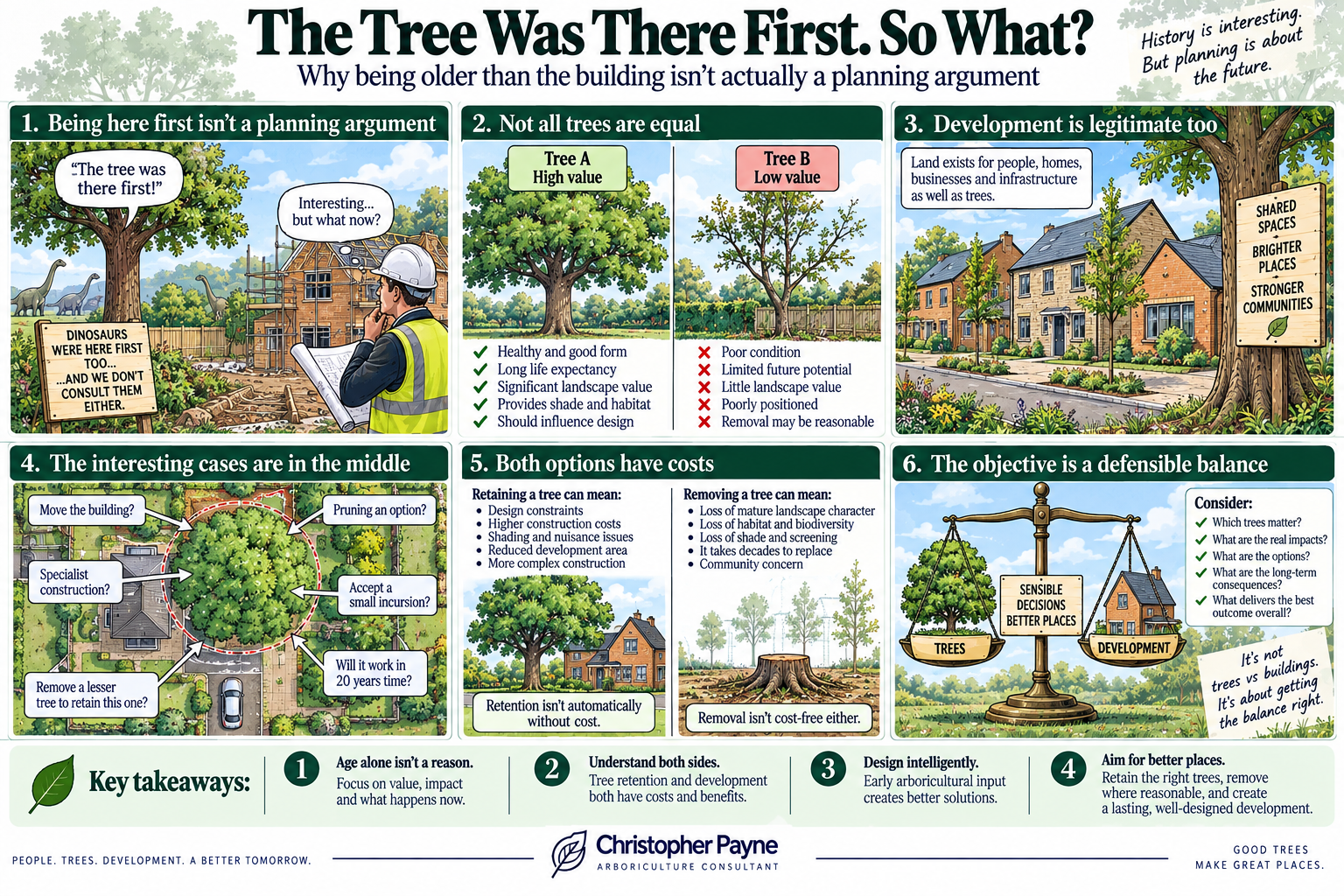
The Tree Was There First. So What?
Why being older than the building isn’t actually a planning argument
“The tree was there first.”
It sounds compelling.
It is also not particularly useful.
Dinosaurs were here before the tree, but we don’t consult them on planning applications either.
Development inevitably changes places.
Trees occupy land. Buildings occupy land. Roads, gardens, parking, drainage, ecology and people all compete for the same finite space.
The real question isn’t who arrived first.
It is what should happen now.
Existing trees matter
A mature tree can make a significant contribution to landscape character and amenity.
Some are prominent landmarks.
Some screen development.
Some have ecological significance.
Some are protected.
Some are simply very good trees.
Existing trees therefore need proper consideration when land is developed.
But “existing” doesn’t automatically mean “untouchable”.
Not all trees are equal
Consider two trees.
Tree A is a mature, healthy specimen with good form, substantial remaining life expectancy and a prominent landscape contribution.
Tree B is suppressed, structurally poor, badly positioned and of limited future value.
Treating them identically because they are both trees isn’t sophisticated arboriculture.
Tree surveys categorise trees precisely because their quality and value differ.
Those differences should influence design.
Development is legitimate too
This sometimes gets lost.
Land exists for purposes other than growing trees.
Homes need building.
Businesses need premises.
Infrastructure needs upgrading.
Existing buildings need adapting.
A technically reasonable arboricultural position has to recognise legitimate development objectives.
The job isn’t to freeze sites at an arbitrary moment in history.
It is to manage change intelligently.
The interesting cases are in the middle
Easy cases aren’t particularly interesting.
An excellent tree nowhere near the development? Retain it.
A terrible tree directly beneath the proposed building? Removal may be straightforward.
Professional judgement becomes important when the answer isn’t obvious.
A good tree partially conflicts with the scheme.
Could the layout change?
Would pruning solve the problem?
Is the RPA incursion actually significant?
Could specialist construction reduce the impact?
Would retention create an unreasonable future relationship?
What would be gained by removal?
What replacement planting could realistically achieve?
Now we are doing arboriculture rather than counting trees.
Tree retention has costs
Retaining a tree isn’t automatically environmentally virtuous if the result is dysfunctional.
A retained tree may force poor building orientation, unusable gardens, excessive shading or an impractical construction arrangement.
Sometimes those effects are acceptable.
Sometimes they aren’t.
They need assessing rather than pretending they don’t exist.
Tree removal has costs too
Removing a tree can mean losing mature canopy, habitat, landscape structure and amenity that may take decades to replace.
That cost is also real.
Which is why “we’ll landscape it afterwards” isn’t always an adequate answer.
The objective is a defensible balance
Good development around trees isn’t created by starting with either:
Nothing can be removed.
or:
Anything in the way can be removed.
Both positions are intellectually lazy.
The useful question is:
Which trees justify influencing the design, to what extent, and why?
Once that is understood, rational decisions become possible.
Some trees stay.
Some go.
Some development changes.
Some doesn’t.
New trees are planted.
And ideally the finished place is better than either side would have produced by treating the argument as trees versus buildings.
The tree may indeed have been there first.
But that isn’t the reason to retain it.
If it stays, there should be a better reason than that.
Christopher Payne | Arboriculture Consultant