Article - Why are Tree Officers so annoying?
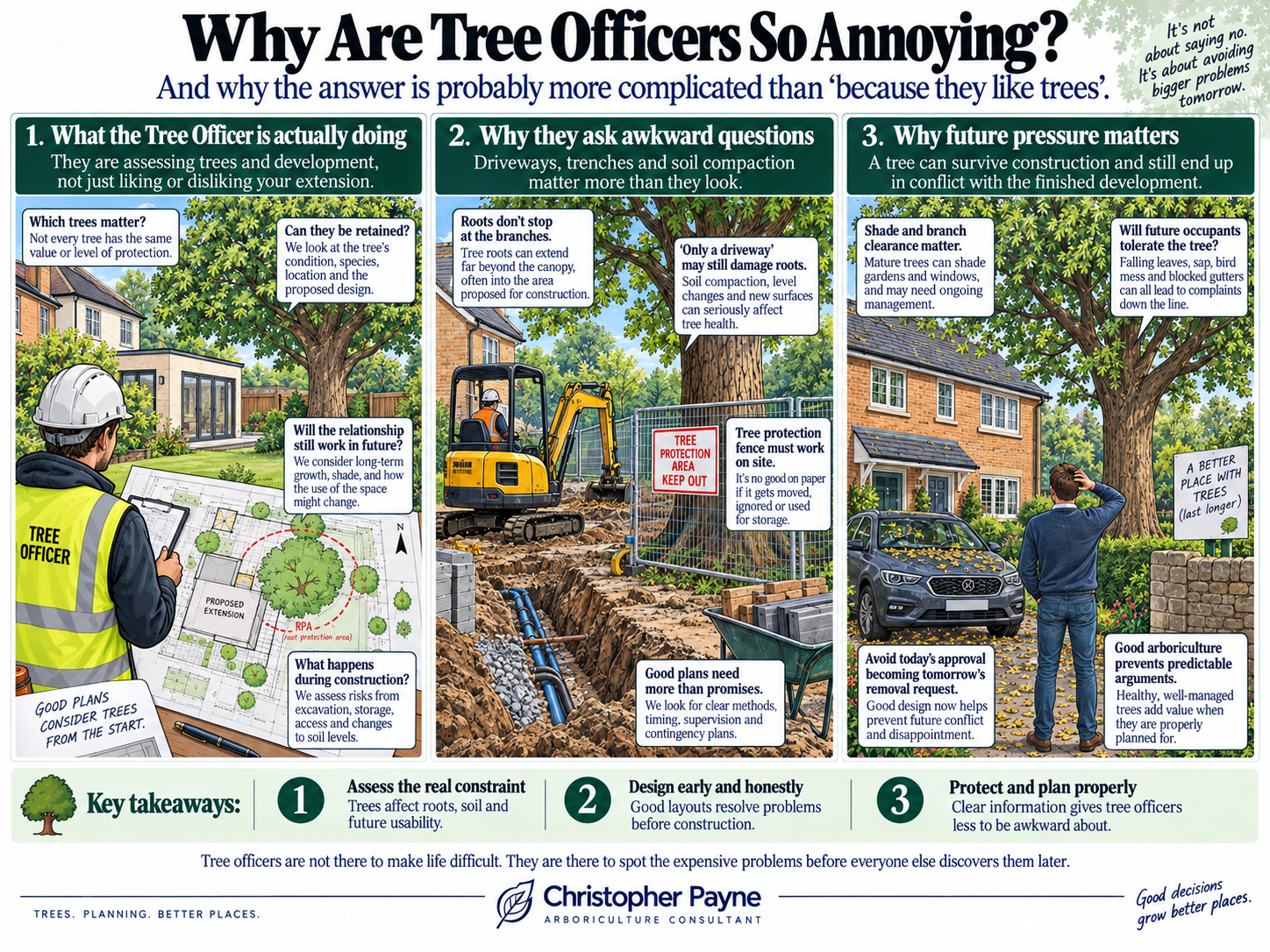
Why Are Tree Officers So Annoying?
And why the answer is probably more complicated than “because they like trees”
You have a perfectly sensible development proposal.
There is a house. There is a garage. There are some parking spaces.
Unfortunately, there is also a tree.
Even more unfortunately, somebody at the Council has noticed it.
Enter the Tree Officer.
Suddenly your perfectly straightforward planning application has acquired coloured circles, strange abbreviations, requests for additional information and an alarming interest in exactly where somebody intends to dig a trench.
Why?
Why can’t the Tree Officer just be reasonable?
As it happens, they probably think they are.
The Tree Officer isn’t actually deciding whether they like your extension
This is the first misunderstanding.
A Tree Officer’s job isn’t normally to decide whether a development should receive planning permission.
Their job is to provide specialist arboricultural advice to the planning process.
That means asking rather narrower questions.
Which trees matter?
Can they realistically be retained?
What effect will the development have upon them?
What effect will the trees have upon the development?
Can construction take place without unacceptable damage?
And will the relationship still work when the shiny new development has become an ordinary building and the trees are considerably larger?
This occasionally produces advice people don’t want to hear.
That isn’t necessarily awkwardness.
Sometimes it’s simply the unfortunate consequence of measuring things.
“But we’re outside the branches”
Excellent.
Unfortunately, the interesting part of a tree doesn’t stop at the branches.
Trees have roots.
This revelation has complicated an enormous number of otherwise excellent planning applications.
Roots need soil, oxygen and water. Construction frequently involves removing soil, compacting it, covering it, changing levels, installing foundations and excavating trenches.
There is therefore something of a clash of interests.
This is why arboricultural drawings contain Root Protection Areas.
The RPA isn’t a claim that every root lives inside a mathematically perfect circle.
Nor does crossing an RPA automatically mean that civilisation will collapse.
It identifies an area associated with the tree’s rooting environment that requires proper consideration.
So when the Tree Officer asks why your proposed garage is sitting inside it, “there aren’t any branches there” may not entirely resolve the matter.
“It’s only a driveway”
The word only performs heroic work in planning applications.
It’s only a driveway.
It’s only a patio.
It’s only a small extension.
It’s only a drainage trench.
It’s only temporary access.
It’s only a little bit inside the RPA.
Trees have a slightly different interpretation of “only”.
A conventional driveway may require excavation and a compacted sub-base.
A drainage trench may cut directly through roots.
Temporary construction access may repeatedly compact soil.
A modest change in level may alter the rooting environment.
None of these automatically makes development impossible.
They simply mean somebody needs to work out what is actually going to happen.
Preferably before the excavator arrives.
The Tree Officer has seen this film before
This explains quite a lot.
On the approved drawing, the tree protection fence is magnificent.
It stands proudly around the tree.
Nothing enters the protected area.
There is ample room for construction.
Everyone is happy.
Three months later the Tree Officer visits the site.
The fence has moved.
There is a pallet of bricks beneath the tree.
A mini excavator is parked beside the trunk.
Somebody has dug a trench through the rooting area.
There is a cement mixer where the protective fencing used to be.
When asked what happened, somebody explains:
“We had to move it so we could get the digger through.”
This experience tends to influence future behaviour.
What may appear to be bureaucratic suspicion is sometimes simply pattern recognition.
“We’ll sort the trees out later”
This sentence has also enjoyed a distinguished career.
Unfortunately, later is often exactly when tree problems become expensive.
Once the building position has been fixed, the road designed, the drainage engineered and the parking spaces squeezed into the remaining land, there may be remarkably little flexibility left.
The tree then becomes “the problem”.
It would have been considerably easier to move a line on a computer six months earlier.
Early arboricultural involvement isn’t about allowing trees to dictate the entire development.
It’s about identifying genuine constraints while the design can still respond to them.
Moving a building slightly at concept stage costs almost nothing.
Moving it after planning drawings, engineering and drainage design have been completed tends to generate considerably less enthusiasm.
Then there is the future
Suppose the development can physically be constructed without damaging the tree.
Good.
Now imagine somebody actually living there.
The mature tree stands immediately outside the principal living-room window.
The room is heavily shaded.
Branches extend above the roof.
Leaves fall into the gutters.
Honeydew lands on the cars.
Occasionally a twig falls off.
At night, during a storm, the tree makes noises.
The new owner telephones the Council.
They want the tree removed.
The tree has a Tree Preservation Order.
Everyone is now unhappy.
The original planning drawing may have demonstrated that the building fitted beside the tree.
It didn’t demonstrate that the relationship worked.
A competent Tree Officer is therefore interested not only in whether development can be built, but whether retained trees and future occupants are likely to tolerate one another afterwards.
This is sometimes called considering future pressure for tree removal.
Another description might be trying to prevent an entirely predictable argument.
“We’ll plant another one”
Replacement planting is valuable.
It is also frequently misunderstood.
A newly planted 12–14 cm girth tree isn’t an instant replacement for a mature tree with a substantial canopy.
It may eventually become one.
That is rather the point of planting it.
But this takes time.
Potentially decades.
Trees aren’t street furniture that can simply be unplugged from one location and installed somewhere more convenient.
Existing mature trees and new planting perform different functions within a development.
Good schemes use both.
Not every tree deserves to stay
This is important.
Arboriculture isn’t a competition to retain the maximum possible number of trees.
Some trees are poor specimens.
Some have limited remaining contribution.
Some are badly positioned.
Some have significant structural or physiological problems.
Some genuinely prevent a sensible development.
Occasionally removing a mediocre tree allows a much better overall design, including meaningful new planting.
A good Tree Officer should recognise that.
The objective isn’t:
TREE = GOOD. BUILDING = BAD.
It is considerably more nuanced.
The question is what matters, what can realistically be retained, what can reasonably be removed and how the development can work with the landscape that remains.
Why do they keep asking for more information?
Because “we’ll be careful” isn’t a construction methodology.
If important trees are being retained close to development, somebody may need to establish:
where protective barriers go;
how demolition will occur;
how ground levels will be managed;
where materials will be stored;
how hard surfaces will be constructed;
where drainage and utilities will run;
whether specialist construction is required; and
whether particular operations require arboricultural supervision.
This is why BS 5837 tree surveys, Arboricultural Impact Assessments, Tree Protection Plans and Arboricultural Method Statements exist.
At their best, these documents turn vague promises into buildable instructions.
At their worst, they are twenty pages of generic text followed by a blurry plan apparently drawn during an earthquake.
Tree Officers tend to prefer the first kind.
And yes, occasionally Tree Officers really are awkward
They are human.
Professional judgement differs.
Some are cautious.
Some have seen enough damaged trees to become very cautious.
Some may concentrate too heavily on tree retention and insufficiently on whether a development can practically function.
Recommendations should still be proportionate, technically justified and related to the actual significance of the trees and the likely effects of the development.
“Because there is a tree” isn’t a technical argument.
Neither is “because the applicant wants to build there”.
Good arboricultural planning sits somewhere between those positions.
The easiest way to deal with an awkward Tree Officer
Give them less to be awkward about.
Provide an accurate tree survey.
Identify the important trees early.
Design around genuine constraints rather than discovering them afterwards.
Show the proposed development and trees clearly on the same scaled drawing.
Deal honestly with incursions into RPAs.
Think about levels, access, services and construction.
Consider what the trees will be like in twenty years.
And if something unusual is proposed, explain technically why it will work.
A good arboricultural submission allows a Tree Officer to look at a proposal and think:
Yes. Someone has actually thought about this.
That is a surprisingly powerful planning strategy.
Perhaps the Tree Officer isn’t the problem
Trees are large, living structures occupying valuable pieces of land.
Buildings need foundations.
Cars need parking spaces.
Developers need viable schemes.
People need homes.
Ecology matters.
Landscape matters.
Planning policy matters.
And somebody eventually has to work out how all of those things occupy the same piece of ground.
That is where arboriculture becomes rather more interesting than simply knowing the names of trees.
So the next time a Tree Officer asks an awkward question, there are two possibilities.
They may indeed be being awkward.
Or they may have noticed something that everyone else would otherwise discover six months later, when changing it costs considerably more money.
Either way, it’s probably worth answering the question.
Christopher Payne | Arboriculture Consultant