Article - Why not just cut all trees down? It would be easier
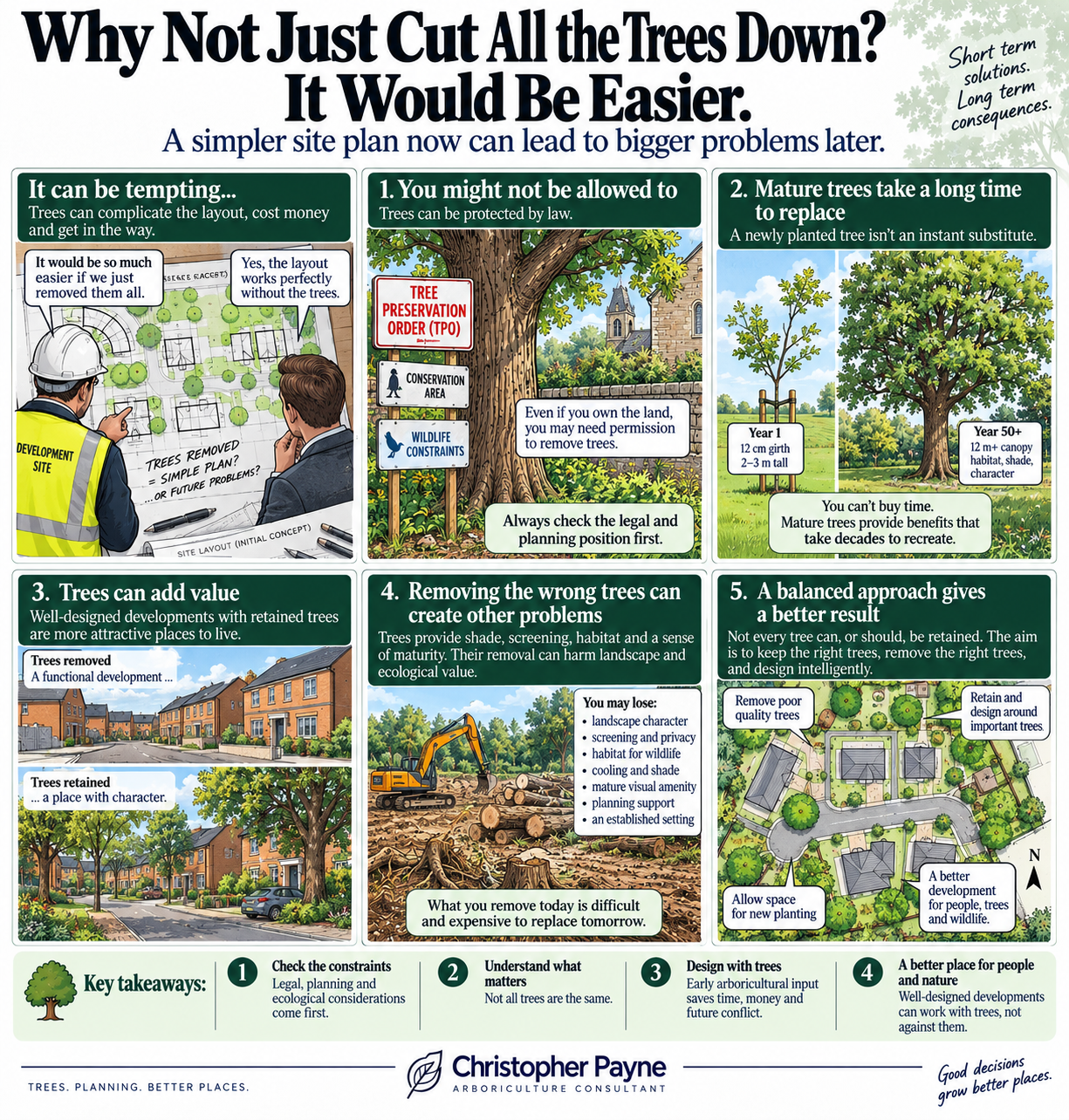
Why Not Just Cut All the Trees Down? It Would Be Easier
It is a perfectly reasonable question.
You have bought a development site. There are trees scattered around it. Some are inconveniently positioned. The architect has produced a beautiful layout which would work perfectly if several large green objects weren’t standing in the way.
So why not just cut them all down?
It would certainly make drawing the site plan easier.
Unfortunately, it may make almost everything else more difficult.
And occasionally illegal.
First, let’s admit something: trees can be inconvenient
There is a tendency in discussions about development and trees to pretend that trees never cause problems.
They do.
Trees occupy space. Their roots occupy considerably more space. Their crowns cast shade. They drop leaves. They grow. Some become structurally unsound. Some are poor specimens. Some are simply in completely the wrong place for a proposed development.
A large mature tree doesn’t become a good candidate for retention merely because it is large and mature.
Likewise, a site containing twenty trees doesn’t necessarily need twenty trees after development.
Good arboriculture isn’t about preserving every tree at all costs.
It is about working out which trees matter, which don’t, and what can realistically coexist with the proposed development.
That distinction can be worth a great deal of money.
The first problem: you might not be allowed to
Before somebody arrives enthusiastically with a chainsaw, there is a rather important question.
Are the trees protected?
Trees may be subject to a Tree Preservation Order. Trees within conservation areas can also be subject to statutory controls. Other legal and planning constraints can arise depending upon the site, the trees, wildlife, planning history and circumstances.
The fact that you own the land doesn’t automatically mean that you can remove whatever is growing on it.
This occasionally comes as a surprise.
The chainsaw is therefore best regarded as Stage 27 of the development process rather than Stage 1.
But suppose the trees aren’t protected?
Excellent.
Can we cut them all down now?
Possibly.
But we still haven’t answered the more useful question:
Should we?
This is where arboricultural assessment becomes valuable.
Imagine a site containing fifteen trees.
Three are mature, attractive specimens with good future potential.
Four are reasonable trees that could be retained without materially compromising the development.
Five are mediocre.
Two are declining.
One is a thoroughly miserable specimen whose principal contribution to the landscape is demonstrating that trees can experience disappointment.
Treating all fifteen trees as equally valuable makes little sense.
So does treating all fifteen as disposable.
A tree survey and arboricultural assessment allow the design team to distinguish between them.
That means the development can respond to the trees that are actually worth responding to.
Mature trees are surprisingly difficult to manufacture
There is an obvious solution to removing existing trees:
“We’ll plant new ones.”
Good.
New planting should be an important part of many developments.
But a newly planted tree isn’t an instant replacement for a mature tree.
A 12 cm girth nursery tree and a mature oak may both technically be described as “one tree”, but this is rather like describing a bicycle and a Range Rover as “one vehicle”.
The arithmetic is correct.
The equivalence is less convincing.
A mature tree may already provide substantial canopy cover, landscape character, shade, habitat and visual screening.
A replacement tree might eventually provide some of those things.
The important word is eventually.
Trees operate on inconveniently long timescales.
Planning applications don’t.
Existing trees can actually help sell the development
Consider two otherwise identical housing developments.
The first consists of houses, roads, parking spaces, close-boarded fences and freshly cultivated soil containing rows of newly planted trees supported by stakes.
The second contains the same new development integrated with several established mature trees.
Which one looks finished?
Existing trees can provide something developers spend considerable sums trying to create: instant landscape maturity.
They can frame views, screen boundaries, soften buildings and give a new development an established character from the day people move in.
That doesn’t mean every existing tree is an asset.
Some are liabilities.
The skill lies in knowing the difference.
Sometimes removing a tree creates a better development
This is equally important.
Retaining a tree badly can be worse than removing it.
Imagine squeezing a house between two trees simply because somebody decided at the beginning of the project that no trees could be removed.
The building avoids the Root Protection Areas.
Success?
Perhaps not.
The living room is permanently shaded.
Branches extend over the roof.
The occupants perceive the trees as threatening.
The garden receives little sunlight.
Within eighteen months somebody applies to heavily prune both trees.
Five years later they want them removed.
Technically, the trees were “retained”.
In reality, the development created a predictable conflict.
Removing one poorer tree during the design stage might have allowed the better tree to be retained successfully for decades.
That is considerably more intelligent than measuring success by counting stumps.
Trees need space above ground as well as below it
Development plans understandably focus heavily on Root Protection Areas.
But roots are only half the tree.
A tree also possesses the inconvenient habit of having a crown.
And crowns grow.
A proposed building might sit neatly outside an RPA while being far too close to the canopy.
This can create problems with shading, dominance, branch clearance, maintenance, gutters and future pressure for pruning.
The correct question isn’t simply:
“Does the building fit outside the RPA?”
It is:
“Can this building and this tree realistically coexist?”
That is a much harder question to answer with a coloured circle.
Then there is biodiversity
Trees don’t exist in ecological isolation.
They may provide nesting habitat, food, shelter, deadwood habitat, cavities and connections through the landscape.
A line of trees or established hedgerow may function very differently from the same number of isolated replacement trees scattered around a development.
Again, this doesn’t mean development becomes impossible.
It means the ecological consequences of removal need to be understood rather than discovered afterwards.
There is a recurring theme here.
Finding things out early is generally cheaper.
What about the planning authority?
This is where removing everything can become particularly counterproductive.
Trees may make a site more difficult to design.
They can also make a development considerably easier to defend in landscape and planning terms.
A scheme demonstrating that the design has responded intelligently to important existing trees tells a very different story from one beginning with comprehensive site clearance.
The first says:
“We understood the site and designed around its important characteristics.”
The second can appear to say:
“We found the easiest place to put the buildings.”
Planning is rarely quite that simple, but perception matters.
So does evidence.
A good arboricultural assessment gives the design team evidence.
The cheapest time to think about trees is before designing the development
This is probably the most important point.
Arboricultural input is often sought after the layout has effectively been completed.
At that stage the tree consultant receives a drawing containing thirty houses, sixty parking spaces, an attenuation basin, a new access road and several trees apparently growing through garages.
The question is then:
“Can you make the trees work?”
Sometimes.
But this is rather like designing a kitchen and only afterwards checking whether the room has a door.
Early arboricultural input changes the process.
Survey the trees.
Identify the important ones.
Identify the poor ones.
Map the constraints accurately.
Then design.
The architect knows where flexibility exists.
The engineer knows where specialist construction might be needed.
The landscape architect knows what existing structure can be incorporated.
The developer knows where the genuine constraints lie.
Everyone’s life becomes easier.
Including the trees’.
And sometimes the answer really is: cut the tree down
There are trees that shouldn’t dictate development.
A poor-quality tree with limited future potential may occupy exactly the piece of land needed to make an otherwise good scheme work.
Removal can be entirely reasonable.
It might even be desirable.
The same applies to trees that are structurally compromised, badly positioned or likely to become increasingly problematic.
Good arboricultural advice shouldn’t consist of finding increasingly inventive reasons why nothing can ever be removed.
That isn’t consultancy.
It is obstruction.
The objective is to reach a proportionate solution.
Retain the trees that justify retention.
Remove trees where removal is reasonable.
Protect retained trees properly.
Plant new trees where they have enough space to become the mature trees of the future.
And make sure the finished development actually works for the people who have to live with it.
So, why not just cut all the trees down?
Because the apparently easiest solution isn’t necessarily the easiest solution.
You may lose valuable landscape features.
You may create planning problems.
You may remove useful screening.
You may lose ecological value.
You may spend considerable money trying to recreate something the site already possessed.
And you may discover that the trees you removed weren’t actually preventing a good development in the first place.
Equally, keeping everything isn’t automatically clever.
The best development schemes don’t begin with either:
“Remove all the trees.”
or:
“Retain all the trees.”
They begin with:
“Which trees are worth designing around?”
That is a much better question.
And, conveniently, it is one arboricultural consultants are quite good at answering.
Christopher Payne | Arboriculture Consultant